Why Is a QA Tester Needed on a Software Development Team?

Software may work well during development and still have problems after release. A feature can fail on another device, break when a user enters unexpected data, or behave differently when several parts of the application work together. QA testers find these issues before the software reaches users.
Catching bugs early also reduces the work needed to fix them. Barry Boehm and Victor Basili found in their Software Defect Reduction Top 10 List that avoidable rework can take up 40% to 50% of a software project's effort.
Their research also found that fixing a problem after delivery can cost close to 100 times more than fixing it during requirements or design on larger projects. For small, noncritical systems, the difference may be closer to 5:1.
QA gives your team a chance to find these problems while they are still easier to fix, instead of leaving them for users to discover after release.
Why Is a QA Tester Needed on a Software Development Team?
Developers do a test run of their product before it goes out. However, when you make something yourself, you already know how it should function. Small problems can be easy to overlook. A QA tester tests the same feature without assumptions. They try it and look for anything that doesn't go as expected.
QA also takes time and money. According to the US Bureau of Labor Statistics, software QA analysts and testers earned a median annual income of $104,300 in May 2025. Once benefits, taxes, and other costs are added, a company typically spends well above the base salary.
There is more code to check now as well. AI tools are helping teams to code faster. In its 2026 report, Faros AI found 54% more bugs per developer during periods of high AI use. It also found a 31.3% rise in pull requests merged without a person reviewing them.
This doesn't mean every small team needs a QA tester today. A small startup product can initially have developers do the testing. The need changes when real customers start using the product. Then bugs can affect orders, data, payments, or other aspects of the business. At that point, someone who finds these problems before they reach production can save the team from fixing them later.
What Does a QA Tester Do on a Software Development Team?
The job is not "clicking around before release." The US Bureau of Labor Statistics lists responsibilities that include creating test plans, identifying project risks, conducting software testing, and documenting defects. In day-to-day development work, those responsibilities usually fall into the areas below (Occupational Outlook Handbook, May 2025 data).
Test planning and strategy
Not every feature needs the same testing, and deciding how much each one needs is a judgment call, not a checklist. A payment flow takes days; a copy change on a settings page takes a glance. The plan also sets what must pass before a release moves forward, which turns “we tested it” into something someone can stand behind. This is what makes the other three worth paying for.
Test case design and execution
QA testers convert a requirement into the specific conditions that would cause it to fail, including those not even stated in the specification. A form works when every field contains what the developer expected. The tester will submit it without the phone number, with the date in an incorrect format, with the name twice, and with a 400-character street address.
Defect identification, reporting, and tracking
It takes more than finding the issue to write a bug report that the development team can reproduce. The report should include the steps that led to the issue, what was expected to happen, and what actually occurred. The second skill is making sure the ticket doesn't quietly age out of the backlog. QA also checks the fix before the issue is closed; teams without that step see the same bug come back three sprints later.
Documentation and results analysis
Testing provides a report on what was done, what wasn't, and what didn't work. Over several releases, that record shows where the next bug will be, which is worth more than any single bug caught.
Three jobs share the title "QA tester"
It's also not a single job, and the three versions cost different amounts. A manual tester performs exploratory and usability testing, edge cases, and unscripted paths; they're the cheapest to hire and the hardest to replace with automation. An automation engineer or SDET writes and maintains the regression suite, operates within the CI pipeline, and is a developer, albeit with a specialization in proving things break. The QA lead is responsible for the release decision, testing strategy, and increasingly for AI-generated tests.
The person you are hiring is most likely the first or the second, and the difference is more significant than it seems from the title.
Why Developers Can't Replace a Dedicated QA Tester
This is the objection most readers will have, so here is the direct answer. Developer testing and QA testing are not the same work done twice. Developer testing is code-level testing and is limited to the paths the developer thought would be called: unit tests, integration tests, and assertions that represent what they believed the code should do. QA testing is user-level and covers paths no one would have even contemplated. Both are required, and a team that has one and calls it the other is exposed.
It's not about their ability. Authors have blind spots relating to their own assumptions. In general, a developer will assume that a date field will always be received in one particular format. Their tests will supply that format every time, and those tests will pass. A tester who doesn't share that assumption enters a different format, and the bug shows up in staging instead of in a support ticket.
In formal terms, QA and QC are two separate entities, and testing falls under QC. The ISTQB glossary defines quality assurance as part of quality management focused on providing confidence that quality requirements will be fulfilled. It defines quality control as activities designed to evaluate the quality of a component or system. In most job postings, “QA” covers all of it.
5 Reasons You Need a QA Tester on Your Development Team
A dedicated QA tester can give your team an independent check before you release software to users. It shows up in five ways: detecting defects early, evaluating requirements outside expected paths, safeguarding user experience, mitigating security and compliance risks, and minimizing rework.
1. Catching Defects Before Users Do
The difference is where bugs are found, not how many there are: a ticket during development versus an incident in production. Finding a defect later costs more than finding it earlier. Boehm and Basili documented a significant increase in that cost when problems remain after delivery, as mentioned above.
The same pattern holds across the industry. The Consortium for Information & Software Quality estimated that the cost of bad software in the USA is around $2.41 trillion.
2. Testing Beyond the Expected Requirements
Checking that a feature works is the easy half. The other half is what the specification meant but didn't say: what happens with 10,000 concurrent users who get a 500 error back from a third-party API, or when a connection drops halfway through an upload. The specification is tested by developers. QA tests what isn't said in the specification.
3. Protecting the User Experience Across Devices and Platforms
The usability and compatibility argument is straightforward. The software runs on the developer's computer, in the developer's browser, at the developer's screen size, with the developer's knowledge of what the button is. None of your users have those. A button that works but that users can't understand is a bug without a stack trace. Missing this doesn't cause an outage. It causes one-star reviews on every platform you didn't test.
4. Testing Security, Compliance, and Access Controls
When money, health, or personal data is involved, a failure is not just a technical problem. The same access-control bug is a breach notification in production and a ticket in staging. The difference between those two outcomes is a QA function that tests permissions, authentication flows, and access boundaries. It does not replace a security engineer; in regulated industries, specialist security testing costs more per hour and does that job better.
5. Reducing Rework, Delays, and Release Risk
Rework is the biggest line item nobody plans for; in Boehm and Basili's data, 40-50% of project effort is rework, and 80% of that comes from 20% of defects. Every hour spent reproducing, fixing, re-testing, and re-releasing is an hour not spent on the roadmap, and predictable releases follow from catching those defects early. So does something more basic: users don't expect software to lose their work or their data.
Why QA Matters More With AI-Generated Code
This is the strongest argument for QA right now, and most articles make it without data. Here is the data.
The AI Engineering Report 2026, released in April 2026 by Faros AI, analyzed two years of data from 22,000 developers and over 4,000 teams to contrast the lowest and highest points in an organization's AI adoption. The pace of output increased: epics completed per developer rose 66 percent, and task throughput rose 33.7 percent. So did the problems.
| What Faros measured | Change under high AI adoption |
|---|---|
| Bugs per developer | +54% |
| Median time in PR review | +441.5% |
| PRs merged with no human review | +31.3% |
| Incidents-to-PR ratio | +242.7% |
| Code churn | +861% |
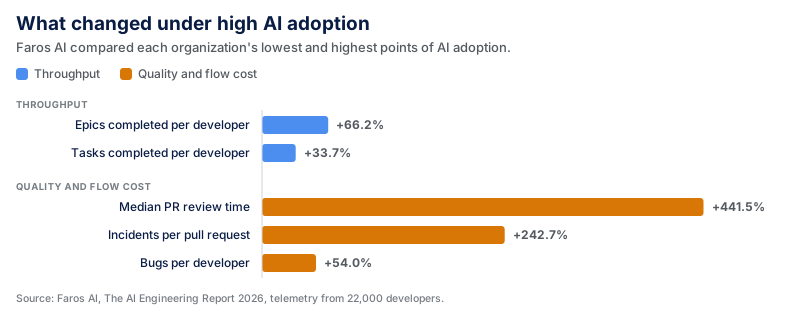
These studies come from commercial sources, so read their findings with that in mind. Still, they point to the same problem: teams are producing more code with AI, while some of that code has more issues and gets less human review. QA adds another check before those problems reach users.
When Do You Need a Dedicated QA Tester?
You may not need a QA tester when your product is still new. At this stage, features change often, and some may be removed completely. Developers can test the main features while the team works out what customers actually need.
QA becomes more useful when you have paying users, and bugs start causing real problems. TestDevLab lists a few signs that can help you decide when it is time to hire a tester:
- Developers spend too much time fixing bugs instead of building new features.
- The team worries about bugs every time a new version is released.
- Bugs lead to lost orders, more support requests, or lost customers.
- New problems keep showing up after releases.
If these problems happen often, your team may need someone focused on testing. If they happen rarely and the product is still small, developers can keep testing it themselves.
You can also use automated tests and a release checklist. Check the main features, browsers, and devices before each release. Decide who will approve the release and when it should be rolled back if something goes wrong.
The eight questions further down can help you decide if it is time to add a dedicated QA tester.
How Much Does a QA Tester Cost, and How Many Do You Need?
QA costs depend on where you hire and whether the tester works in-house or on an outside team.
| Arrangement | Cost | Notes |
|---|---|---|
| In-house QA engineer (US) | $104,300 median annual wage | BLS, May 2025 |
| Outsourced, offshore | $15–$50/hour | Lower rates are common for manual testing |
| Outsourced, nearshore | $35–$75/hour | Common range for LATAM and Eastern Europe |
| Outsourced, onshore US/UK | $60–$150+/hour | Rates can be higher for security or compliance work |
Checked September 2026. Outsourcing rates are based on Appsierra's 2026 cost guide. These rates come from a company that provides outsourced QA services, so actual quotes may differ.
The number of QA testers you need also varies by project. A Prolifics Testing survey of 29 organizations found that the most common ratio was one tester for every three developers. The answers varied widely, from teams with no testers to one tester for 30 developers.
Some projects need more testing. MIT's ORBIT knowledge base points to a 3:1 developer-to-QA ratio for highly regulated work, such as healthcare IT and financial services.
You may need fewer testers when automated tests already cover most repeat checks. A product with frequent releases, little test automation, or a high cost of failure may need more QA support.
Do You Need a QA Tester? 8 Questions to Ask
Not sure if it is time to hire a QA tester? Ask your team these eight questions:
- Do paying customers use the product to store their data or make payments?
- Has a customer found a bug in the last 90 days before your team noticed it?
- Do developers spend more than one day a week fixing old bugs?
- Does your team worry about bugs before a release?
- Does your product need to work on different browsers, operating systems, or devices?
- Do you need to meet standards such as HIPAA, PCI DSS, GDPR, or SOC 2?
- Is AI used to write a large part of the code your team releases?
- Have you ever rolled back a release because of a bug that could have been found during testing?
If you answered yes to six or more, a dedicated QA tester may already make sense for your team.
If you answered yes to three to five, you may need one soon. Keep an eye on bugs, release problems, and the amount of time developers spend on testing and fixes.
If you answered yes to two or fewer, you may not need a full-time QA tester yet. Automated tests and a simple release checklist may be enough for now.
A startup may need its first QA engineer after the MVP has paying users and releases become harder to manage. If the product is still changing often and the team is testing different ideas, developers can usually handle basic testing.
Frequently Asked Questions
How many QA testers do we need per developer?
One QA tester for every three to five developers is a common starting point. In a Prolifics Testing survey of 29 organizations, one tester for every three developers was the most common answer. Projects with strict security or compliance needs may need more QA support. The amount of test automation also affects how many testers you need.
What does a QA tester cost?
The US Bureau of Labor Statistics reported a median annual wage of $104,300 for software QA analysts and testers in May 2025. Outsourced QA rates can range from about $15 to $150+ per hour based on location, experience, and the type of testing required.
What is the difference between QA, QC, and testing?
QA focuses on the process used to maintain software quality. Quality control, or QC, checks whether the finished product meets its requirements. Testing is one of the ways teams find problems in the software. In software teams, these terms are sometimes used together even though they have different meanings.
Can't developers test their own code?
Developers should test their own code, but they may not find every problem. They already know how the feature was built and how it should work. A QA tester checks other user paths, inputs, devices, and situations that the developer may not have tested.
Is QA still needed if AI writes our tests?
Yes. AI can help teams write tests faster, but those tests still need to be checked. AI-generated code can also contain bugs or miss cases that were not included in the prompt. A person still needs to decide what should be tested and whether the software is ready to release.
Does automation replace a manual tester?
Not completely. Automated tests are useful for checks that need to be repeated often. A QA tester is still needed for new features, unusual user actions, and problems that automated tests were not written to find.
The Bottom Line
QA helps teams find software problems before users do. Developers test their own work, while QA gives the product another check before release.
Not every small team needs a dedicated QA tester from the start. The need usually grows when you have paying users, release more often, support several devices or platforms, or start seeing more bugs in production.
AI tools can help developers write code faster, but faster development also means more code needs to be checked. Testing remains an important part of releasing software that works as expected.
At Coding Crafts, QA is part of our software development process from the first sprint. We set the release requirements early and test the product as development moves forward. Learn more about our software development services.
Quality is a role, not a hope
Every Coding Crafts project ships with dedicated QA: manual, automated, and security testing built into the sprint, not bolted on at the end. Senior teams at $25 to $49 per hour.
More from the blog.
View all postsRelated reading from the Coding Crafts team.