Forward Deployed Engineer vs Solutions Engineer: Which Role Does Your Product Need?

Even the best products can lose sales because the prospect can't demonstrate that it will work in their environment. It can even close deals and then not move forward with integration and deployment for months. These are two different types of problems, and the wrong customer facing technical hire can result in the true pain point being left unaddressed.
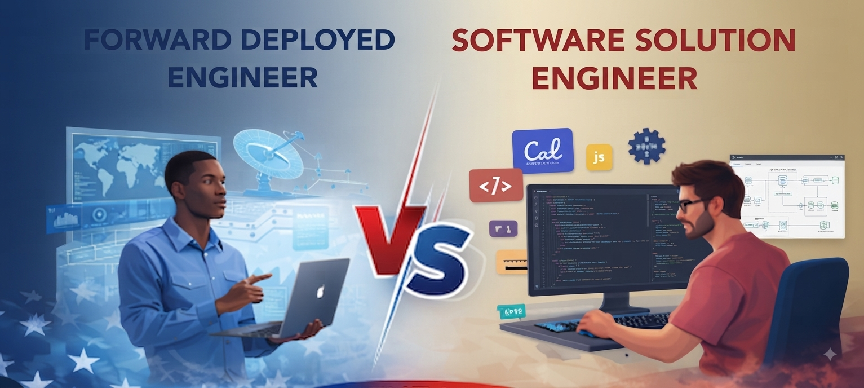
The difference in the forward deployed engineer versus a solutions engineer is that one is practical. The Solutions Engineer's primary job is to be the technical win, understanding the requirements, being able to demonstrate the fit, run POCs and clear technical objections on a variety of opportunities. A Forward Deployed Engineer delves into implementation, coding, integration issues and assumes more responsibility for getting the product up and running in the customer's environment.
It is not as straightforward as before sale versus after sale. If a product comes into contact with production data, infrastructure, security systems or complex customer environments, meaningful evaluation can sometimes be necessary before the contract is finalized, often accomplished by having engineers deployed ahead of time. Technical validation vs. ownership of production, and breadth of deals vs depth in accounts is more useful.
Both are common among early-stage founders. This is because the company needs to distinguish itself in getting the technical decision right from ensuring the deployment is successful, as it grows.
This guide will give you a breakdown of what each role actually owns, the cost difference, the working style, when you need to use either FDE or SE and which to use based on your product and customer journey.
What Each Role Actually Does
It's easier to see the difference when you see the work, not the title. One role typically is distributed among opportunities, where it is to create technical confidence for buyers. The other is inside fewer accounts for a longer period of time to solve the engineering challenges from “we bought it” to “it works in production”.
This boundary may vary based on the product. Products which require technical skills and infrastructure, security, data, and agent based products can begin deployment work before evaluation, since a controlled demo may not be enough to show that the product will function with the customer's real systems.
What a Forward Deployed Engineer Does
Forward Deployed Engineer provides technical support in or in conjunction with the customer's technical environment. Common tasks involve production coding, integration development, API and data flow debugging, deployment configuration and troubleshooting anything that falls outside of the scope of standard product features.
The effort is often focused on a limited number of accounts within the first 90 days. The engineer will gain a deep understanding of the customer's architecture and constraints, and deploy and manage technical work for the customer. More complex engagements can take weeks or even months as opposed to simply a successful proof of concept.
The role also ties in deployments to customers back to product development. When multiple customers need the same workaround or integration, it's a red flag that the feature is likely to be core and not just custom engineering.
Forward deployment is sometimes defined as post-sale, but that's changing. In other cases, such as infrastructure, security, data, and complex artificial intelligence products, a technical assessment might be needed before signing a contract with real customer systems. In these situations, it is necessary to deploy earlier, since a sandbox POC is not possible to prove the fit in production.
What a Solutions Engineer Does
A Solution Engineer (SE) is mostly involved in assisting prospects in figuring out whether a product will solve their technical issue. Discovery calls, custom demos, design solutions, proofs of concepts, integration discussions and addressing technical objections in the buying process.
With the first 90 days, it's all about the breadth. A new hire usually moves from the product and shadowing calls to conducting discovery, demo, and POCs on a few opportunities before taking on this role on their own.
The key outcome is the technical victory - the prospect has confirmed that the proposed solution fulfils their needs. After closing, detailed implementation work is typically transferred to the engineering, deployment, implementation, or customer success teams.
The result is a clear separation: the pre-sales team is responsible for showing the value of the solution; the forward deployment team is responsible for the more complex engineering to make it work in the customer's environment.
Forward Deployed Engineer vs Solutions Engineer: What’s the Difference?
Both have customer facing aspects, but they are owned differently. The Solutions Engineer usually validates the technical fit on a variety of deals and the Forward Deployed Engineer bears more responsibility for the product to be up and running in the customer's environment.
| Dimension | Forward Deployed Engineer | Solutions Engineer |
|---|---|---|
| Customer lifecycle stage | Usually deployment/post-sale; may join pre-sale when production access is required | Primarily pre-sale, from discovery through technical validation |
| Primary output | Working production deployment or integration | Technical win that supports the buying decision |
| Code depth | Production code, APIs, integrations, debugging, and data workflows | Demos, configuration, scripts, architecture, and POC code |
| Ownership model | Deep focus on a few customer environments | Broad coverage across multiple opportunities |
| Success metric | Time to production, deployment reliability, adoption, and delivered value | POC success, technical wins, pipeline influenced, and deal conversion |
| Team alignment | Product, engineering, and customer technical teams | Sales, AEs, prospects, and product specialists |
| Typical engagement length | Weeks to months | Usually follows the sales cycle |
| Travel | Depends on deployment complexity and need for on-site engineering | Depends on enterprise sales meetings, workshops, and POCs |
It is the distinction between the breadth and the depth that is the most useful, rather than pre-sale versus post-sale. A pre-sales specialist can do multiple discovery calls, demos and POCs in one day. That same day, an engineer deployed could be working with one customer's developers to solve a problem with an integration or looking into a production problem.
The division is helpful when it comes to hiring: You need greater solution capacity when deals are being slowed down by technical uncertainty. When customers are purchasing, but not getting to production, they probably need forward-deployment capacity.
Understanding the Cost of FDE and SE Talent
The salary comparison is just a single factor. Employers should also take into account headcount used per role.
The US 2026 data shows, the salary for a Forward Deployed Engineer typically ranges from $150,000 to $240,000+ and can be significantly higher at the more senior and well-funded tech companies when equity is added. FDEs with experience are as valuable as their experience, as their job involves blending, engineering, and good judgment related to the customer.
Solutions Engineer jobs tend to be more sales-based. According to current U.S. standards, many mid-level positions pay between $110,000 and $150,000 in base pay and between $130,000 and $180,000 in total compensation. Senior jobs can be as high as $140,000 to $190,000 base salary with variable compensation of 10 to 30 percent on revenue or sales, for a total salary of $170,000 to $240,000.
The larger disparity in hiring is in utilization. An SE can be involved in multiple opportunities simultaneously and distribute the investment across the sales pipeline. An FDE typically invests a lot of engineering effort across fewer customers, resulting in a higher cost per customer deployment.
The distinction is crucial for workforce planning: FDEs are typically closer to engineering or R&D capacity used to handle customer issues, whereas SEs are typically sales capacity that supports revenue. An FDE that is viewed as a more technical SE can easily confuse and skew CAC and staffing assumptions.
Numbers of course depend on location, seniority, company's stage of growth, product complexity and whether it's equity or not, so these are more useful as ranges of the market in 2026 than as an absolute budget for hiring.
How to Decide Which Role Your Team Needs
Don't make your choice based on the job title. Begin at the choke point: Do customers experience difficulties when they are trying to establish that the product is effective before purchase, or when they are trying to make the product effective after purchase? One of the most evident differences in existing FDE hiring practices is ownership of the production.
You Need a Solutions Engineer If
Use solutions capacity when:
- Customized demos / POCs are required for prospects.
- AEs require technical assistance with architecture, API, security, or integrations.
- Technical fit cannot be verified by buyers, and transactions stall.
- Many opportunities can be supported by one specialist.
- Not much production engineering is necessary for product evaluation.
The issue in this case is technical confidence, prior to buying. The role's job is to get the prospect to a technical “yes”.
You Need a Forward Deployed Engineer If
The first rule of forward deployment is:
- Customers need to write their own code or complicated integration.
- The core engineers are continually invited to implementations.
- Customer close but slow to production.
- When there are repeated product gaps that surface during deployments.
- Each customer's environment varies from other customers.
- Real data or production systems are essential to properly evaluate the product.
The last is important. For products that require a lot of infrastructure, deployment expertise might be required before selling, since a sandbox cannot reveal the limitations that come in the production environment. The features of production code and ownership of the outcome continue to be the defining features of this work.
What If You Need Both?
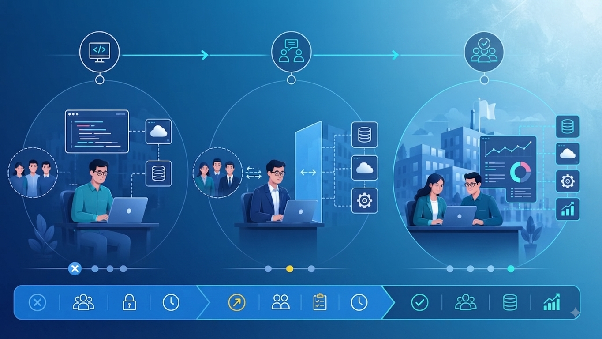
Both are required when production deployment and technical validation are distinct, repetitive tasks. Discovery, POCs and technical validation are the elements of the solutions side. At the point, when production code, integration depth, and problem solving depending on the environment is required, it's time to switch to deployment engineering.
A simple test is:
Deals slow down before technical approval → improve solutions engineering.
Customers get stuck between purchase and production → tighten the forward deployment.
Both occur regularly → develop both skills with explicit transition.
How FDEs and Solutions Engineers Work Together
Both positions are responsible for connecting the production outcome to the sales promise. The important thing is establishing when the shift from technical validation to implementation will take place.
From Technical Discovery to Proof of Concept
Discovery of needs, architecture, integrations, security restrictions, and success criteria is led by the pre-sales side. With those findings, the demo or POC is built around the technical questions which could derail the deal.
Introduce deployment skills early for validation needs involving real customer data, custom code or production infrastructure. This will pick up any implementation risks before they become commitments.
From Proof of Concept to Production
If the POC is successful, it means that a method is viable. Production brings other needs - authentication, scale, monitoring, failure handling, security and maintainability.
Now the deployment engineer becomes more involved, converting the validated method into actual code, integrating it with the customer's system and solving problems that are unique to the environment. Ownership of production is an important difference between these jobs.
Where the Handoff Happens
The handoff should occur when the work is no longer about proving technical fit but about a production outcome; not necessarily at the signing of the contract.
The agreed architecture, POC results, integration requirements, security constraints, success criteria, known limitations and commitments during the sales process should be provided to the implementation team.
Can a Solutions Engineer Become a Forward Deployed Engineer?
Yes. There are some shared skills between the two roles: technical discovery, solution design, customer communication, API knowledge and the understanding of taking business needs and converting those to technical decisions. In fact, solutions engineering is a common background for a forward deployment.
The greater transformation is from the proof of solution to the ownership of a solution in production. A strong person at demos and POCs might also require more experience in writing tested and maintainable code, debugging live integrations, deployment infrastructure and systems post-launch. Ownership of production codes is always seen as one of the most obvious distinctions between the jobs.
The manner of working also shifts. Pre-sales benefits from having a wide perspective: qualify faster, gain insights into various customer situations, manage objections and navigate between multiple deals. Forward-deployment: "the reward for depth" -- stick with a hard problem, understand a single environment thoroughly, implement the fix in that environment, and be held accountable for the results.
Specifically, for an SE looking to make the transition, the best preparation is to do something other than take the title test. Own production grade integrations, extend backend and infrastructure capabilities, troubleshoot integration failures and complete integrations beyond POC. Customer facing judgment is generally a good transfer – it is typically the production engineering that needs to be worked out.
Need Help Hiring the Right Engineering Talent?
Choosing between two job titles is not the more challenging option. It's defining the level of pre-sales technical expertise that your team requires, or the level of ownership of your production deployment.
CodingCrafts supports organizations to bring in senior engineering expertise, depending on the work product to be accomplished. Engineers are sorted, vetted for code quality and system design, and then seamlessly integrated into the client's team and process. For businesses that require more than one hire, we offers flexible staff augmentation and dedicated-team options.
Looking for engineering capacity and a short hiring cycle? Discuss with CodingCrafts the type of talent and team required for your product.
Senior engineers, matched to the work
Coding Crafts vets engineers for code quality and system design, then integrates them into your team, from solutions work to forward-deployed delivery.
More from the blog.
View all postsRelated reading from the Coding Crafts team.