Outsourced IT Services: The Complete 2026 Guide
Companies outsource IT work to access technical skills, increase development capacity, and manage technology tasks efficiently. These tasks can include software development and cloud management to cybersecurity and even technical support.
The internal team can retain control over business priorities and technical decisions. External specialists handle the given tasks under a contract.
Deloitte’s 2024 Global Outsourcing Survey of more than 500 executives found that 80% planned to maintain or increase third-party outsourcing. This guide explains how IT outsourcing works, service options, costs, rates, risks, and the steps for outsourcing IT work.
Outsourced IT Services at a Glance
Companies can outsource individual IT functions without handing over the entire technology operation. Co-managed IT services divide responsibilities between internal and external teams. The internal team sets priorities and approves technical decisions. The external team completes the assigned work.
Cost depends on location and internal involvement. Using the figures in this guide, a US software developer costs about $198,500 per year fully loaded. A senior engineer contracted through an Asian company charges $59,500 to $78,700 per year.
The contract price does not show the full expense. Handover and management time reduce the estimated saving from 60–70% to 44–53% in the worked example.
Internal ownership is super important after outsourcing. Again, your team has to review the work done, and approve final deliverables.
Who This Guide Is For
This guide is built for companies with roughly 20 to 300 employees and a small internal technical team. This assists businesses in deciding which IT functions to handle in-house and outsource.
Outsourced IT Services Explained
Outsourced IT services means hiring an external company to perform specific technology work. The external company provides the specialists and manages the work agreed in the contract.
Companies can outsource a software project, continuous IT support, or dedicated engineers who work with the internal team. The cost, management structure, and responsibilities depend on the type of service.
What to Outsource and What to Keep In-House
| Service | What an external team handles | What stays with you |
|---|---|---|
| Software development | Web, mobile, and custom applications from MVP through enterprise systems | Product decisions, priority order, and what “done” means |
| Cloud services | Migration, infrastructure management, and cost optimization | Which workloads matter and what downtime is acceptable |
| Cybersecurity | Monitoring, threat detection, compliance evidence, and audits | Risk appetite and access decisions |
| IT support and helpdesk | User support, device management, and issue resolution | Escalation policy and which requests get rejected |
| Managed infrastructure | Servers, networks, backups, and uptime monitoring | Recovery targets and the decision to invoke them |
| Data and analytics | Pipelines, warehousing, reporting, AI, and ML work | The questions worth answering and what the answers mean |
Your internal team handles the responsibilities in the right-hand column. The outsourcing company manages delivery but your team still controls the major decisions.
Fully Managed vs Co-Managed vs Staff Augmentation
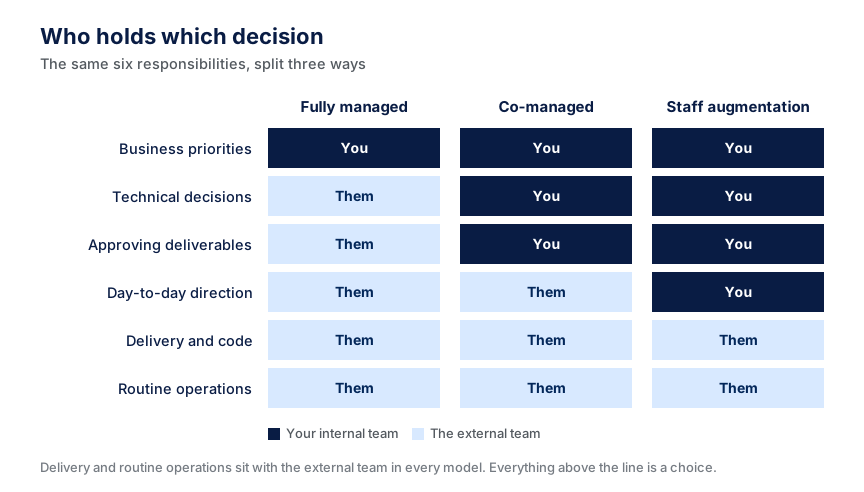
Each setup gives the external team a different level of responsibility. In a fully managed option, the external team runs the IT function. Co-managed divides the work between both teams. Staff augmentation places external specialists under your internal team’s direction.
| Model | What it covers | Who directs the work | Best fit |
|---|---|---|---|
| Fully managed | A complete function delivered against agreed service levels | The external team operates within limits you set | Well-defined and measurable functions such as helpdesk, monitoring, and backups |
| Co-managed | The external team runs routine delivery and your people keep the judgment calls | Your lead sets priorities and their lead manages delivery | Companies with one or two strong internal technical people and no bench |
| Staff augmentation | Named specialists work inside your existing team and process | Your team directs the work day to day | Companies that already have leadership and a backlog but lack capacity |
Co-managed IT keeps product and technical decisions with your internal team. Your product owner and tech lead manage the roadmap, architecture, and approval of completed work. The external engineering team handles development from the same backlog and follows your review standards. Both teams work on the same project under the same process.
Why Companies Outsource IT
Companies outsource IT to access specialist skills. An external company may already have security, cloud, or software specialists available for the project.
Outsourcing also allows companies to increase or reduce team size through contract terms instead of permanent hiring. Offshore and nearshore teams can lower labour costs compared with US-based development.
External teams also use experience from similar projects. A team that regularly handles cloud migrations or software projects already knows the common technical problems and delivery steps.
In-House vs Outsourced vs Co-Managed IT
| Factor | In-house | Fully outsourced | Co-managed |
|---|---|---|---|
| Cost profile | Fixed; salaries continue between projects | Variable; contracted per hour, month, or deliverable | Mostly variable with a small fixed internal core |
| Control | Your company directs everything | Your company sets outcomes rather than day-to-day methods | Internal leaders retain important decisions and delegate delivery |
| Time to start | Recruiting can take weeks or months | Often days to weeks depending on available staff | Often days to weeks because your internal core already exists |
| Talent access | Your local hiring market plus people willing to relocate | Global access to specialist skills | Global delivery with internal business context |
| Security and IP | Managed inside your own controls | Depends on NDAs, IP assignment, and access controls | Similar external risks with internal technical review |
| Knowledge retention | Knowledge stays internally until employees leave | Knowledge can leave with the external company without proper contract terms | Core knowledge remains with your internal team |
| Fails when | You cannot keep the team busy or cannot hire | Nobody internally can specify or accept work | Your internal lead is already at capacity |
For software projects, our in-house vs outsource software development cost guide compares both models in more detail.
Onshore vs Nearshore vs Offshore Rates
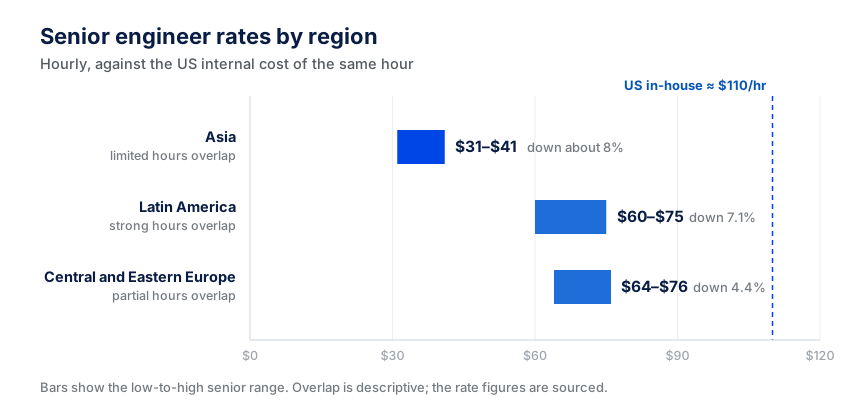
Location changes two important factors: hourly rates and working-hour overlap. Onshore teams usually have the highest rates but have the same or similar working hours. Nearshore teams offer lower rates with good time-zone overlap. Offshore teams usually charge the lowest labour rates but usually have fewer shared working hours.
| Region | Junior rate | Senior rate | Year-on-year change |
|---|---|---|---|
| Asia (South and Southeast) | $24–$31/hr | $31–$41/hr | Down about 8% |
| Latin America | $33–$45/hr | $60–$75/hr | Down 7.1% |
| Central and Eastern Europe | $31–$39/hr | $64–$76/hr | Down 4.4% |
Rates from Accelerance’s 2026 outsourcing rate report, published 24 November 2025 after a survey of 60 software development partners. Figures checked on 17 September 2026.
Rates come from Accelerance’s 2026 outsourcing rate report. Outsourcing rates have fallen in several regions. Older data can therefore show higher prices.
The table does not show an onshore rate because the Accelerance report provides figures for Asia, Latin America, and Europe. Adding a US agency rate without a reliable source makes the comparison difficult.
The US calculation below still provides a useful cost reference. It puts the internal employment cost at about $110 per productive hour before an agency adds operating expenses and profit margin. Onshore outsourcing provides external talent but offers lower labour savings.
Nearshore teams cost more than offshore teams but usually share more working hours with US companies. At these rates, a senior Latin American engineer costs roughly twice as much as a senior Asian engineer. Higher rates matter more when projects involve frequent meetings and live communication. Our offshore outsourcing guide explains the model in more detail.
Outsourced IT Services Cost
Here is a twelve-month comparison for one engineer using the national software developer median as the in-house benchmark.
The Bureau of Labor Statistics puts the median annual wage at $135,980 as of May 2025. The Employer Costs for Employee Compensation for March 2026 puts management and professional compensation at $78.10 per hour worked, compared with $53.50 in wages.
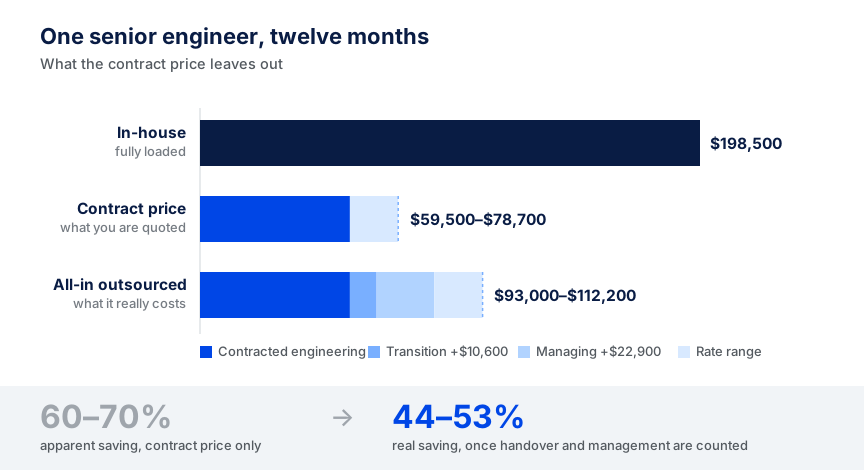
Benefits account for 31.5% of total compensation. This gives a loading multiplier of 1.46 and raises the annual employment cost to about $198,500. At 1,800 productive hours per year, the internal cost works out to about $110 per productive hour.
A senior engineer in Asia at $31 to $41 per hour costs about $4,960 to $6,560 per month, or $59,500 to $78,700 per year. The rates come from the Accelerance 2026 outsourcing rate report.
The contract is not the only expense. Transition and the management also take time from the internal team.
| Line item | Formula | Worked example |
|---|---|---|
| Contracted engineering | Rate × billed hours | $31–$41 × 1,920 = $59,500–$78,700 |
| Transition and handover | Internal hours × loaded internal rate | Product owner and tech lead, 8 hrs/week each for 6 weeks = 96 hrs × $110 = $10,600 |
| Managing the relationship | Manager hours per week × 52 × loaded internal rate | 4 hrs/week = 208 hrs × $110 = $22,900 |
| All-in outsourced | Sum of the three rows above | $93,000–$112,200 |
| In-house comparison | Median wage × 1.46 | $198,500 |
Add your own figures to the calculation. Subtract transition and management expenses for a more realistic cost comparison.
Outsourcing costs 44% to 53% less than in-house hiring. Removing internal overhead increases the apparent savings to 60% to 70%.
Those two rows account for about $33,400 a year. Leaving them out makes the financial difference look larger than it is.
Fixed-scope projects work differently because their price depends on the agreed project.
Outsourcing Risks and Contract Terms
Most outsourcing risks depend on the contract terms. Set responsibilities before signing. A clear agreement states who owns the code, how each side handles security, and how parties can end the contract. It should also explain payment terms, project changes, and delivery responsibilities.
| Risk | What it costs you | What to put in the contract |
|---|---|---|
| Named engineers change without warning | Your team spends months rebuilding context | Named individuals, substitution notice, and interview rights for replacements |
| Low rates lead to expensive rework | A $30/hr engineer who redoes half the work effectively costs $60/hr | Monthly defect and rework reporting |
| Ownership of work is unclear | Due diligence or a funding round can stall | Written assignment of work product covering AI-assisted code and open-source components, plus disclosure of AI tools that access your codebase |
| Knowledge stays with the external company | Leaving becomes difficult and expensive | Repositories and cloud accounts in your name, dated runbooks, and a paid transition period |
| Service levels have no consequences | Targets exist without meaningful protection | Response and resolution targets, measurement rules, named owners, and service credits |
Two warning signs deserve attention. A proposal should show the price, timeline, team, process, review stages, and delivery schedule. The outsourcing company should also identify the engineers assigned to the project before signing.
The contract should state the termination notice period and how the company will transfer source code, documentation, system access, and credentials. In the same Deloitte survey, 70% of executives said they had brought outsourced work back in-house during the previous five years.
When Not to Outsource IT
Internal hiring works well for long-term product development. Permanent employees keep product knowledge and continue working on the same codebase after projects end.
Data and regulatory rules can limit where teams store, access, or process information. Check these restrictions before selecting a development location.
Some work does not justify a software outsourcing team. For example, a company looking for one part-time on-site helpdesk specialist can hire locally or work with a managed IT company.
How to Outsource IT Services
IT outsourcing takes more than choosing a company and signing a contract. Decide what the external team will handle, estimate the hours, assign approvals, and set a communication process. Compare rates, review past projects, and agree on ownership and exit terms.
These seven steps explain how to choose an outsourcing company and prepare for the project.
1. Identify the Skills and Hours
List the technical skills your internal team does not have and estimate the hours for each one. For example, list 80 hours of cloud engineering or 160 hours of frontend development instead of asking for one developer. Also record the decisions your internal team will control, such as product priorities, architecture, and release approval.
2. Choose the Outsourcing Model
Decide who will assign work, manage engineers, review deliverables, and approve releases. A fully managed team handles delivery. A co-managed team shares the work with your employees. Staff augmentation gives external engineers under your internal management.
3. Set the Working Arrangements
Set shared working hours for both teams. Agree on the working language, meetings, response times, escalation contacts, and holidays. Record these details before the project starts.
Choose the main communication tools and decide where the team will track tasks. Set a clear contact person on each side for questions and urgent issues. This keeps communication clear during the project.
4. Review Potential Companies
Check verified client reviews and projects with similar technologies. Ask for client references and speak with a current and former client where possible. Additionally, inquire about missed deadlines, engineer replacements, communication problems, and how the company solved these issues.
5. Compare Proposals on the Same Basis
Review the team, hourly rates, estimated hours, contract length, and services in each proposal. Add transition expenses and the value of your team’s management time. Calculate the total project or annual cost instead of comparing hourly rates alone.
6. Agree on Contract Terms
Record the assigned roles, rates, payment schedule, IP ownership, system access, security responsibilities, documentation standards, service levels, and termination terms. The contract should explain how the outsourcing company will transfer source code, credentials, documentation, and project knowledge at the end of the agreement.
7. Set Up the Engagement
Give the external team access only to the systems used for its work. Assign one internal owner to answer questions and approve deliverables. Set a clear deliverable for the first two weeks. Review code quality, communication, and delivery before assigning more work.
Frequently Asked Questions
How Much Do Outsourced IT Services Cost?
A full-time senior engineer in Asia charges $25 to $49 per hour for outsourced development services. A full-time engineer working 160 hours per month costs about $4,000 to $7,840 per month.
What Is the Difference Between Managed Services, Outsourcing, and Staff Augmentation?
Managed services assign a specific function to an external company. Whereas, the staff augmentation places external engineers under your management.
Is IT Outsourcing Only for Small Companies?
No. Small companies use outsourcing to access skills without permanent hiring. The large organizations consider it for additional capacity and specialist work.
Is Outsourcing IT Services Safe?
Security depends on contract terms and access controls. Keep control of system access, source code, cloud accounts, credentials, and project documentation.
Final Takeaways on Outsourced IT Services
Keep decisions about your product, customers, business priorities, and acceptable risks within your company. External teams can manage delivery and clearly specified operational work.
Fully managed services work well for measurable functions like helpdesk support, monitoring, and backups. Co-managed teams provide additional engineering capacity. Whereas, your internal technical leaders retain product and technical decisions.
Cost comparisons should account for the contract price and internal employee time. Add transition and ongoing management expenses before comparing outsourcing with internal hiring.
Calculate the total with your own salaries, outsourcing rates, working hours, and expected workload before choosing a model.
Work With Coding Crafts
Coding Crafts provides co-managed engineering teams for companies that want to retain product and technical decisions internally. Your lead sets priorities, approves deliverables, and controls the roadmap.
Our senior engineers handle development at $25 to $49 per hour. A project manager manages tasks, timelines, communication, and delivery.
Bring your version of the cost table above. We will add our rates, estimated hours, and management expenses so you can compare the total with your internal hiring cost.
Bring your numbers, we will fill in ours
Coding Crafts provides co-managed engineering teams with senior engineers at $25 to $49 per hour and a project manager who owns tasks, timelines, and delivery. Your lead keeps the roadmap.
More from the blog.
View all postsRelated reading from the Coding Crafts team.