Custom Software Development Cost in 2026
Custom software development costs vary from project to project. The price changes with features, user roles, integrations, design, security, data, and the development team. Two products can solve a similar business problem but have very different costs. The reason is usually the development work involved.

A cost estimate alone is not enough. You should know how many development hours the project takes, the hourly rate, what the quote includes, and which expenses continue after launch. These details show what you are actually paying for.
This guide explains how custom software costs are calculated. It breaks down a mid-complexity project, compares labour rates, explains the main cost factors, and calculates the cost of owning the software for three years.
Custom Software Development Cost Summary
The summary below shows the estimated budget, development hours, regional rate differences, and ongoing maintenance costs.
- Custom software development typically costs $25,000 to $500,000 or more. The cost of the software mainly depends on the complexity and labour rate.
- A mid-complexity project in this guide takes 2,400 hours and costs $88,800 at $37 per hour. With a 15% contingency, the estimated budget reaches $102,120.
- Development location also changes the price because hourly rates vary by region. Maintenance cost is also relevant and it is usually about 15% to 25% of the initial build.
Custom Software Development Cost by Complexity
Software complexity changes the amount of development work and the project timeline. The table below compares three common complexity levels and their estimated costs.
| Complexity | What it includes | Timeline | Cost |
|---|---|---|---|
| Simple | One core workflow, standard UI, no or one integration, one user type | 2–4 months | $25,000–$60,000 |
| Mid-complexity | Several user roles, two or more integrations, custom design, reporting, audit trail | 4–8 months | $60,000–$150,000 |
| Enterprise | Complex workflows, high availability, compliance framework, many integrations, legacy migration | 8–18+ months | $150,000–$500,000+ |
These ranges are calculated using a development rate of $25 to $49 per hour. The software functions determine the complexity level.
For example, a small startup can still have a mid-complexity project if the product has several user roles, payments, reporting, and CRM integration. A larger company may find a simple software useful if it handles one specific business process.
Market data also shows different price ranges. GoodFirms' 2026 survey found that 65.7% of vendors charge $30,000 to $100,000 for a typical project. Clutch reports an average project cost of $132,480, but most custom software projects on its platform cost between $10,000 and $49,999.
ScienceSoft estimates 500 to 700 hours for simple software, 700 to 1,200 hours for medium projects, and more than 1,200 hours for complex products. Its categories differ from the ones in this guide. So, compare the features and work in each project instead of the category names.
How Product Type Changes Custom Software Cost
As stated above, some types of software cost more because they involve extra security, compliance, or integrations. Healthcare software can involve patient data and clinical systems. Fintech products often handle payments, financial information, and regulatory work. Logistics software includes maps, live tracking, and warehouse systems.
Cleveroad calculates healthcare software at $75,000 to $250,000+, logistics software at $50,000 to $250,000+, and fintech software at $90,000 to $300,000+.
These figures are general estimates. The actual price depends on the features, user roles, integrations, and development hours.
What Affects Custom Software Development Cost?
Custom software development cost depends on a few main factors. The features you build, integrations you add, project complexity, and team rates all influence the final price. Let’s discuss these factors in detail.
1. Features and Workflows
A feature costs more when it has more functions. For example, a basic reporting feature may show fixed reports. A more complex version can have filters, exports, scheduled reports, and different access levels. The same applies to payments, search, dashboards, and messaging. More functions take more development hours and increase the cost.
2. Third-Party Integrations
Integrations link your software with payment systems, CRMs, email services, maps, accounting tools, and other platforms. A well-documented API usually takes less time to integrate than an older system with limited documentation. Cleveroad charges $5,000 to $20,000+ for a third-party integration. Connecting an ERP or legacy system can cost $10,000 to $50,000+.
3. Software Architecture
Software architecture decides how the application, database, and services work together. A simple system has fewer components. Microservices and distributed systems take more development hours because several services have to communicate and run separately.
Complex architecture can add $50,000 to $150,000+ to a project. Architecture planning can range from $10,000 to $50,000+.
4. UI and UX Design
A standard interface costs less than a fully tailored experience. Animations, interactive elements, dashboards, and unique components increase design and frontend hours.
Cleveroad estimates UI/UX work at $5,000 to $15,000+ for basic projects, $15,000 to $30,000+ for medium complexity, and $30,000 to $50,000+ for advanced products.
Internal tools can often rely on ready-made components. However, the customer-facing products usually involve more visual and interaction work.
5. Device Support and Responsive Design
Customer-facing software should work properly on desktop, tablet, and mobile screens. More layouts and screen variations increase the design and development work. Responsive design can cost $10,000 to $25,000+. The final amount depends on the number of screens and layouts.
6. Localization
Software used in several countries often supports different languages, currencies, date formats, and local rules. The team also has to translate interface text, adjust layouts for longer words, format numbers correctly, and check each version before launch.
Localization can cost $10,000 to $30,000+ per language. The amount changes with the number of screens, content volume, and changes needed for each market.
7. Security and Compliance
Software that stores customer, financial, or health data usually requires more security work. Developers handle login security, user permissions, encryption, activity logs, secure APIs, and backups. Projects that follow HIPAA, SOC 2, or another compliance framework involve additional controls and reviews.
Security, scalability, and performance work can cost $20,000 to $100,000+. An external penetration test can add another $5,000 to $20,000 per assessment. The amount depends on the data, system size, and security standards involved.
How to Calculate Custom Software Development Cost
Calculate the development cost from the total project hours and the team's hourly rate. Add contingency and other project expenses to get the working budget.
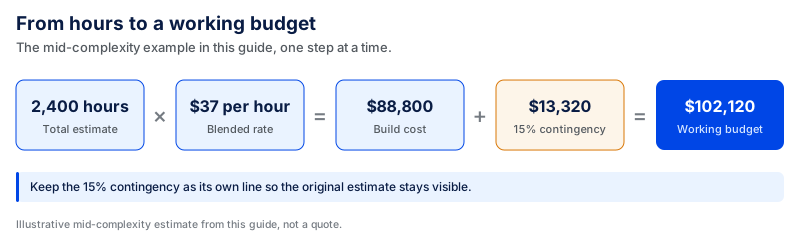
Development cost \= total development hours × blended hourly rate
The hours usually come from discovery, design, frontend development, backend development, QA, DevOps, and project management.
For example, a project estimated at 2,400 hours costs $88,800 at $37 per hour. Adding a 15% contingency increases the working budget to $102,120.
The formula also explains why two vendors can quote different prices for similar software. One company could estimate more hours and another charges a higher rate. The final quote can also change when one estimate contains work that another leaves out. Ask for both the hours and hourly rate to compare the estimates accurately.
Custom Software Development Cost Breakdown
The example below shows the development hours for a mid-complexity software platform. The product has three user roles, two integrations, filterable reporting, an audit log, and managed hosting.
Note: It is an illustrative estimate and the calculation uses a blended rate of $37 per hour.
| Line item | Share | Hours | Cost at $37/hour |
|---|---|---|---|
| Discovery, requirements, and project management | 8% | 192 | $7,104 |
| UX/UI design and solution architecture | 7% | 168 | $6,216 |
| Backend engineering | 40% | 960 | $35,520 |
| Frontend engineering | 25% | 600 | $22,200 |
| QA | 16% | 384 | $14,208 |
| DevOps, environments, and release | 4% | 96 | $3,552 |
| Build total | 100% | 2,400 | $88,800 |
| 15% contingency | $13,320 | ||
| Total budget | $102,120 |
The backend takes the largest share because the example has several user roles, integrations, reporting, and an audit trail. A product with a simpler backend and more custom interface work would have a different distribution.
The 15% contingency provides room for changes and uncertainty during development. It should remain separate from the estimated build cost so the original estimate stays visible.
Custom Software Development Cost by Region
The labour rate can change the project budget even when the development hours remain the same.
The table below applies different rates to the same 2,400-hour project.
| Development team | Rate | Build cost | 15% contingency | Total |
|---|---|---|---|---|
| Coding Crafts | $37/hour | $88,800 | $13,320 | $102,120 |
| Asia-based agency | $33/hour | $79,200 | $11,880 | $91,080 |
| Latin America agency | $54/hour | $129,600 | $19,440 | $149,040 |
| European agency | $54/hour | $129,600 | $19,440 | $149,040 |
| US in-house team | $93/hour | $223,200 | $33,480 | $256,680 |
Accelerance reports hourly rates of $24 to $41 in Asia, $33 to $75 in Latin America, and $31 to $76 in Europe. The table uses the rounded midpoint for each region.
For the US in-house estimate, BLS reports a median software developer salary of $135,980 per year. After employee benefits, the estimated employment cost reaches about $194,000 per year, or $93 per hour.
The project still takes 2,400 hours in each example. Only the labour rate changes, which shows how team location can increase or reduce the budget.
These figures do not account for every expense. An in-house team also has recruitment, equipment, onboarding, and management costs. Outsourcing still takes time from your own staff to review work and answer project questions.
Scope Decisions That Increase Software Development Cost
Some project decisions have a larger effect on the budget than small changes to the hourly rate.
| Decision | Development work | Published cost |
|---|---|---|
| Third-party integration | Authentication, API work, error handling, data exchange | $5,000–$20,000+ each |
| Legacy or ERP integration | Discovery, custom connector, data mapping | $10,000–$50,000+ each |
| Distributed architecture | Microservices and supporting infrastructure | $50,000–$150,000+ |
| Architecture planning | System structure, components, data model | $10,000–$50,000+ |
| Custom UI | Components, animations, interactions | $5,000–$50,000+ |
| Responsive design | Layout work for different screen sizes | $10,000–$25,000+ |
| Localization | Translation infrastructure and locale handling | $10,000–$30,000+ per language |
| Security and performance work | Access controls, encryption, caching, scaling | $20,000–$100,000+ |
| Penetration test | External security assessment | $5,000–$20,000 per test |
The figures above come from Cleveroad and are general estimates. Some decisions do not have one fixed price because they change several parts of the software. Single sign-on, offline access, multi-tenancy, and compliance frameworks fall into this category.
For example, multi-tenancy changes permissions, data separation, and administration. Offline access involves local storage and data syncing. Compliance frameworks introduce additional security controls. These items should appear separately in the project estimate.
Scope or Hourly Rate: Which Changes the Cost More?
Both scope and hourly rate change the project cost. Reducing the rate from $45 to $40 on a 2,400-hour project saves $12,000.
Two third-party integrations can cost $10,000 to $40,000, while distributed architecture can add $50,000 to $150,000+. These decisions can have a bigger impact than a small change in the hourly rate.
Team location creates a larger rate difference. Within the same region, reducing unnecessary features and technical work can save more than negotiating a few dollars off the hourly rate.
Custom Software Costs After Launch
Software expenses continue after the initial development work. Maintenance, hosting, licenses, API usage, security assessments, and internal staff time should form part of the long-term budget.
- Maintenance: Annual maintenance typically costs 15% to 25% of the initial build. It pays for bug fixes, security updates, dependency upgrades, and small product changes.
- Scope changes: GoodFirms reports that 65.6% of vendors in its 2026 survey saw scope creep increase project costs by 10% to 25%. A contingency helps prepare for these changes without hiding them inside the original estimate.
- Security assessments: Software that stores customer information can also have external security expenses. Published penetration testing estimates range from $5,000 to $20,000 per assessment.
- Internal staff time: The client’s team lead has to answer questions, review work, approve decisions, and provide feedback during development. This time has a business cost even though it does not appear on the development invoice.
- Hosting and third-party services: Cloud infrastructure, email, messaging, storage, analytics, maps, payment services, and other tools often charge according to usage. These expenses usually grow as the product gains users.
Three-Year Custom Software Cost
The initial development budget does not represent the full cost of owning custom software.
The table uses the $88,800 build and shows three-year costs with 15% and 25% annual maintenance. The initial budget also includes a 15% contingency.
| Item | Year 1 | Year 2 | Year 3 | Three-year total |
|---|---|---|---|---|
| Build with contingency | $102,120 | – | – | $102,120 |
| Maintenance at 15% | $13,320 | $13,320 | $13,320 | $39,960 |
| Maintenance at 25% | $22,200 | $22,200 | $22,200 | $66,600 |
| Total at 15% maintenance | $142,080 | |||
| Total at 25% maintenance | $168,720 |
The initial development budget makes up about 72% of the three-year total with 15% maintenance and 60% with 25%.
Hosting, licenses, API fees, penetration tests, and internal staff time are separate expenses. Their costs change with the product and usage. A three-year estimate gives you a more accurate budget by accounting for expenses that continue after launch.
When You Should Not Build Custom Software
Custom software is not always the most economical option. Existing products, prototypes, or smaller first releases can solve some problems at a much lower cost.
You should reconsider custom development when:
- Your budget is below $10,000. Coding Crafts has a $10,000 minimum project size. At a smaller budget, an existing product or limited proof of concept is usually more practical.
- Existing software handles most of the workflow. Paying for a subscription can cost much less than rebuilding functions that already exist. Custom development becomes easier to justify when the missing functionality has a clear business value.
- The product idea has not been validated. Building a complete platform before confirming demand puts a large budget behind an assumption. A prototype or MVP gives the team a smaller way to validate the product first.
- Nobody will own the software after launch. Custom products continue to change after release. Someone has to prioritize updates, review problems, answer development questions, and approve future work.
Custom development becomes more practical when existing software cannot handle an important workflow, integration, business model, or technical process.
How to Reduce Custom Software Development Cost
Careful planning and clear priorities reduce custom software development costs. Focus on essential features, choose suitable technologies, and avoid unnecessary complexity to control development hours and keep the project within budget.
Launch With Core Features
The first release should contain the main features users rely on. Secondary functions can come later. This reduces development hours and gives you real user feedback before spending more on the product.
Reduce Integrations
Each integration increases development time and future maintenance. Keep the first release limited to important systems such as payments, CRM, or accounting software. Less important data transfers can use manual imports or exports until automation becomes necessary.
Avoid Complex Architecture Too Early
New products often work well with a simple architecture. Microservices and distributed systems increase development and operating costs. Move to a more complex structure when higher traffic or technical limits make the change necessary.
Use Existing Services
Existing services can handle payments, authentication, email, messaging, maps, analytics, and storage. Integrating them usually takes less time than building these systems from scratch. This reduces development hours and future maintenance work.
Build an MVP First
Build an MVP with only the core features first. This allows you to collect user feedback before adding more functions and reduces spending on features customers may not use.
How to Compare Custom Software Development Quotes
Compare the details of each quote before looking at the final price. Check the development hours, hourly rates, project assumptions, excluded work, and how the company charges for future changes.
- Project scope: The estimate should list the user roles, major features, integrations, reports, and other important functions.
- Hours by role or phase: Separate hours for design, frontend, backend, QA, DevOps, and project management show where the budget goes.
- Hourly rates: Ask for the rate by role or the blended rate used in the calculation.
- Assumptions: The estimate should state which APIs, data, content, credentials, and other items the client will supply.
- Exclusions: Maintenance, hosting, licenses, security assessments, and other excluded expenses should appear in writing.
- Change process: The quote should explain how additional work is estimated and approved.
A cheaper quote may leave out features, integrations, or other development work. Compare what each company includes before sealing the deal.
Questions to Ask a Software Development Company
Before choosing a software development company, ask questions to understand how the company calculates the cost, estimates development hours, and handles changes during the project. This will help you compare quotes and know what you are paying for.
Which features can move to the next release?
This shows which functions are important for launch and which features can be added later. Moving secondary features to a later version reduces the initial development hours.
What hourly rate and development hours are you using?
These numbers show how the company calculated the quote. They also make it easier to compare estimates from different teams.
What happens if the project takes more work than estimated?
Check whether the quote includes contingency and how the company charges for additional work. This helps you avoid unexpected charges during development.
Which integrations are included in the price?
Confirm the exact systems covered by the quote and whether the team has worked with them before. An unfamiliar or poorly documented system can take longer to integrate.
What will the software cost after launch?
Get estimates for maintenance, hosting, licenses, security work, and support. These expenses continue after the initial development ends.
What type of project would you turn down?
The answer shows what the company does not build and whether your project matches its experience.
How Coding Crafts Estimates Its Projects
Coding Crafts develops custom software for founders and businesses. Our published Clutch profile lists project rates of $25 to $49 per hour and a minimum project size of $10,000.
Our estimates break the project into development work rather than giving one unexplained total. This helps clients see the scope, estimated hours, labour rate, and major assumptions before development starts.
One example is a credentialing platform developed for a healthcare organization. The project was delivered over 10 months and reduced provider onboarding from two to four weeks to one to two weeks. The case study reports the project outcome rather than its development cost.
For a new project, the final estimate depends on the workflows, user roles, integrations, security work, design, and technical architecture.
Frequently Asked Questions
How much does it cost to develop custom software?
Custom software typically costs $25,000 to $60,000 for simple projects, $60,000 to $150,000 for mid-complexity platforms, and $150,000 to $500,000+ for enterprise systems.
How is custom software development cost calculated?
Multiply the estimated development hours by the hourly rate. Add contingency, hosting, licenses, third-party services, and security expenses.
How long does custom software development take?
Simple software usually takes two to four months, while mid-complexity projects take four to eight months. Enterprise systems can take eight to eighteen months or longer.
Why do software development quotes vary?
Companies use different development hours, hourly rates, features, integrations, and exclusions. Compare these details to understand the difference between quotes.
Does the development location change the cost?
Yes. Labour rates vary by region. So, the same number of development hours can result in a different total cost.
How much does software maintenance cost?
Annual maintenance typically costs 15% to 25% of the initial build. The amount changes with updates, integrations, security work, and ongoing improvements.
Is custom software cheaper than off-the-shelf software?
Not always. Existing software usually costs less when it already handles your main workflows. Custom development works better for specific processes or integrations.
How much should I budget beyond the development quote?
Budget for maintenance, hosting, licenses, third-party services, security assessments, and internal staff time. These expenses continue after the initial build.
Get a real quote, not a range
Ranges are for articles. Coding Crafts scopes your actual requirements with senior engineers and returns a transparent, line-item estimate at $25 to $49 per hour, usually within days.
More from the blog.
View all postsRelated reading from the Coding Crafts team.