AI Agents in Finance: Use Cases, Architecture, and How to Deploy Them

Many finance teams are already using automation to handle invoice processing, reconciliation, reporting, and fraud checks. Gartner's 2025 AI in Finance Survey found that 59% of finance leaders were using AI in their finance function, compared with 58% in 2024 and 37% in 2023. Gartner noted that adoption remained largely steady in 2025 after the sharp increase seen the previous year. Traditional automation, though, works best for processes with a fixed flow. When an invoice is missing information, two records differ, or a transaction requires additional investigation, someone generally has to jump in.
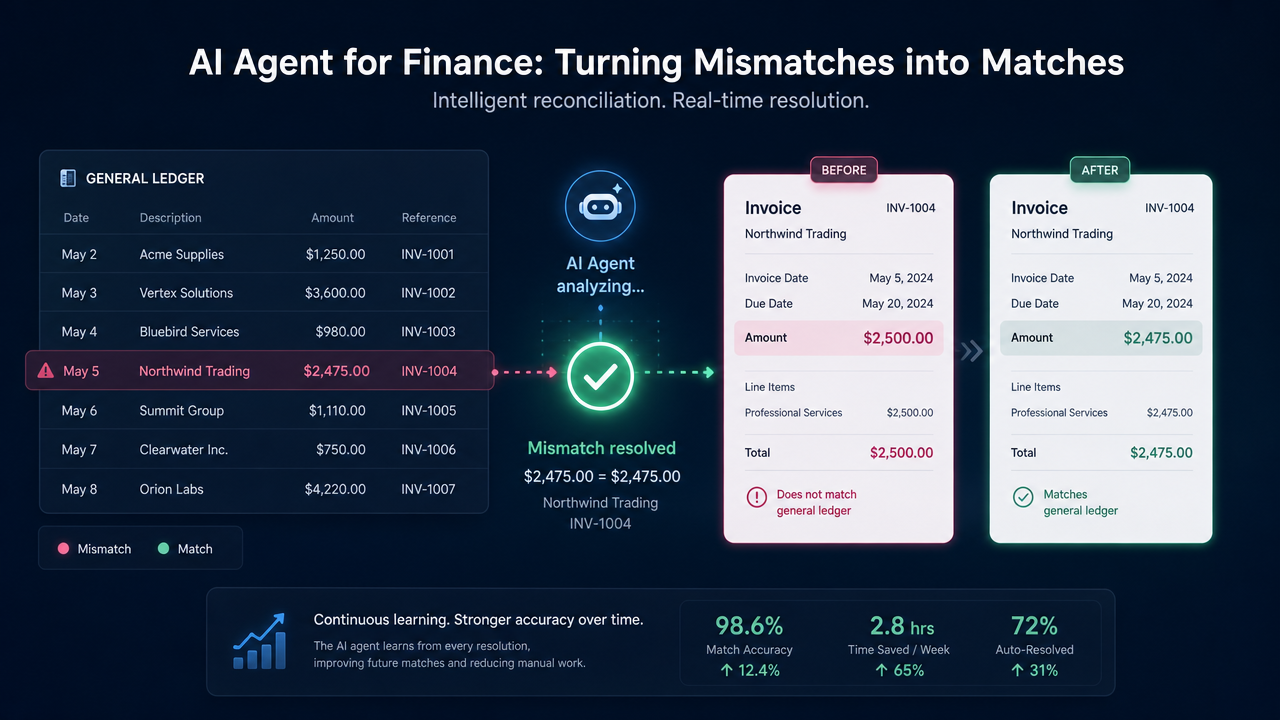
Finance agents can use artificial intelligence to handle more of these evolving, multi-step processes. Rather than repeating the same steps, an agent can understand the job, collect data from various systems, decide what to do, use the required resources, and escalate the case for human judgment if needed.
For example, to pay an invoice, an accounts payable agent would read the invoice, compare it with the purchase order, consult the vendor record, flag or investigate any discrepancies, gather supporting details, and then submit it for approval. Its actions depend on what it encounters.
In short, a finance agent uses context, reasoning, tools, permissions, and evaluation to complete financial workflows. Its ability to take an action does not automatically give it the authority to do so, especially when money or sensitive financial records are involved. Running it safely also requires ongoing monitoring, infrastructure, integrations, and maintenance beyond the initial build.
This guide is for finance leaders evaluating where AI agents make sense and engineering teams responsible for building and deploying them safely.
What Are AI Agents in Finance?
In finance, artificial intelligence agents are software systems that can take actions to achieve a financial objective, make decisions, and use tools connected to the system. They don't always need to be programmed in advance, as basic automation does.
Let's take an invoice processing example. Traditional automation would extract invoice information, compare it to a purchase order, and then send the invoice for approval. The process can stop if key data is missing or doesn't match its records. McKinsey describes conventional automation as rule-based technology that follows predefined instructions, including finance tasks such as invoice processing, reconciliation, and basic reporting.
An agent can investigate further. It can validate the vendor record, look for the purchase order in the ERP, verify previous payment history, determine the cause of the discrepancy, and prepare the case for approval. The next step depends on what the agent discovers.
The main difference between agents and traditional automation is their approach.
| Comparison | RPA | Chatbot | AI Agent |
|---|---|---|---|
| What starts the process? | A predefined event or rule | A user question or request | A goal, event, or change in a workflow |
| Does it follow a fixed path? | Usually yes | Mostly follows a conversational flow | Not always. It can decide the next step based on what it finds |
| What information does it use? | Data from predefined systems and workflows | Information available to the chatbot | Data from approved systems, documents, databases, and APIs |
| What can it do? | Complete predefined tasks | Answer questions or provide information | Investigate, make recommendations, prepare actions, or execute approved actions |
| Where is human input needed? | Mainly for exceptions | When the user needs to review or act on the response | For approvals, exceptions, and actions that should not be fully automated |
There are three things an agent typically must have to do so. It requires context to understand the task and to remember what has transpired. It requires reasoning to decide how to move forward. And it requires tools that enable it to communicate with internal systems like the ERP, database, document store, email system, or API.
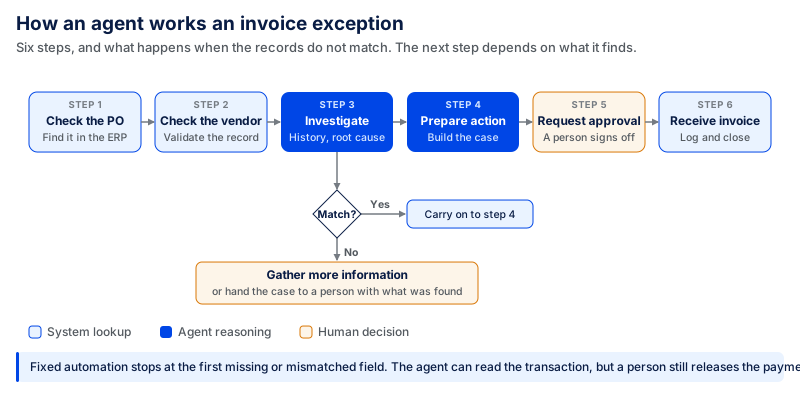
When all the details match, the process can proceed. If there is an issue, the agent can gather additional information or pass the case to another person.
Finance is an appropriate field for this approach because it has many repetitive tasks coupled with exceptions that need to be investigated. People often need to navigate multiple systems to get an answer in reconciliation, AP/AR, FP&A, fraud reviews, and financial analysis.
But if an agent can do something, that doesn't mean it has the right to do it without restrictions. An agent might be able to read a transaction or prepare a payment, but a human still needs to approve the payment release. Getting the right mix of automation and control is crucial, particularly in financial applications.
AI Agent Use Cases in Finance
The best use cases are not necessarily time-consuming tasks. They are workflows that involve many people gathering information, comparing it with rules or other documents, investigating exceptions, and determining the next action. Agents can take part in more of this process while still involving people in decisions that affect finances or regulations.
Financial Planning and Analysis (FP&A)
FP&A teams invest considerable time collecting actuals and verifying them against budgets and forecasts, as well as uncovering the reasons for changes in the numbers. McKinsey reports that, across a handful of finance functions where AI had been adopted robustly, finance professionals spent 20–30% less time crunching data. An agent can combine these steps into a workflow.
For example, it might fetch actuals from the ERP, compare them with the forecast, identify a large variance, pull supporting sales or expense data, and produce a report for the analyst.
This is where the agent comes into play: variance analysis, forecasting support, management reporting, and scenario analysis. The analyst remains responsible for financial judgment, but spends less time searching for and organizing the information needed to make it.
Accounts Payable and Accounts Receivable
Both AP and AR involve repetitive tasks such as invoice matching, payment tracking, account reconciliation, and customer follow-ups, and although they can be automated as far as possible, exceptions make it challenging. On the payable side, the agent can read an invoice, locate a purchase order, check vendor information, match the details, and determine whether anything is missing or conflicting. On the receivable side, it can follow up on payments, verify payment history, prioritize accounts for collection, and write customer reminders.
The problem comes when these systems are in production. Vendor records might be outdated, invoices may come in different formats with regional and business-unit payment terms, and approvals may differ. A successful tool call doesn't help if the financial data is incorrect. Higher-risk actions like changing vendor details and releasing payments should therefore typically be under clear permissions and approvals.
Coding Crafts has seen similar gains from AI-supported financial workflows. In one AI-powered financing platform, time to next action dropped from 48 hours to around 18–24 hours during trial usage. Application completion improved by approximately 8–15%, while document requests per application decreased by approximately 15–25%. These results came from a financing workflow rather than an AP system, but they show why teams should measure the outcome of the complete financial process, not just whether the AI produced a response.
Financial Close and Reconciliation
The agent can match bank transactions with the ledger, identify unmatched transactions, locate documents, and create exceptions for review. It can also carry over context when switching between the ERP, general ledger, payment systems, and other data sources.
Reconciliation becomes harder when systems represent the same transaction differently. The workflow therefore depends on reliable data mapping and a trusted source of truth. The agent should also check the end result of the reconciliation, not assume that each reconciliation step succeeding means the accounts are correct.
Risk, Fraud, and Compliance
Fraud investigations typically aren't based on a single signal. The analyst might require historical transactions, identity details, device activity, sanctions information, prior cases, and external information before making a decision.
An agent can collect these signals, review suspicious activity, explain why the activity was flagged, and create a case for review. It's different from a rule-based workflow that follows a fixed path. An agent's investigation can vary depending on what information surfaces during the process. This is helpful because fraud patterns can change over time. The attacker may modify their approach to the rule, making it less effective.
Determining risk and taking action against a customer are two different levels of authority. A transaction could be automatically investigated and flagged by an agent, but freezing an account, rejecting a customer, or blocking a payment requires more evidence or human approval.
Investment Research and Financial Analysis
Financial statements, earnings reports, regulatory filings, market data, company announcements, and past research can all provide information for financial analysis. Analysts can review these sources before taking a stance on a stock.
An agent can gather the relevant data, compare companies or reporting periods, pinpoint changes in the financial numbers, and create a first-pass analysis. It can also provide a traceback to the underlying sources, supporting citation and provenance.
The agent is not meant to replace the investment decision-maker. It's about saving analysts time collecting and organizing information so they can spend more time analyzing its meaning.
Customer Service and Financial Operations
Customer inquiries can start off as a simple question, but they can escalate into a multi-system workflow. For example, a customer might ask why their payment was unsuccessful. An agent might identify the customer, go back to the transaction, check its status, review the account details, determine the probable reason, and explain the next steps. If it is an operational matter, it can either take action or pass it to the right person.
These workflows can be applied to other financial services, such as disputes, collections, account servicing, and insurance operations.
The level of permission also matters in these workflows. The implications of answering a question, updating a customer's properties, and transferring funds differ significantly. The agent should therefore have access only to the information required for the task at hand, and human approval should be required for any sensitive or irreversible actions.
What Makes AI Agents Valuable in Finance?
The worth of agents isn't just that they can automate much more work. They can link steps typically taken by humans to move from one system to another, investigate exceptions, and decide what to do next. This can help streamline financial workflows without removing humans from the process when needed.
Faster Financial Workflows
Many finance processes aren't slow during the steps, but between them. Data is exported from one system, checked against another source, compared to see why it doesn't match, an email is sent, and then approval is awaited.
An agent can connect these steps into one workflow, carrying the relevant context forward instead of requiring a person to repeatedly move information between systems. Saving time isn't just about producing information faster; it's about reducing handoffs and searches.
Less Manual Work Without Removing Human Judgment
Not all financial decisions are created equal, and not all should be automated. Agents can handle the work while leaving the final decision to the right person. They may gather documents, review records, reconcile differences, make recommendations, or draft an action before requesting approval.
If tasks involve lower risk, more steps can be automated. Human judgment can be integrated into the workflow for actions like blocking customer accounts, changing financial records, or releasing payments.
Better Visibility Across Financial Systems
Financial information is typically distributed across various systems, such as ERPs, CRMs, payment systems, spreadsheets, document stores, and more. To determine what happened, employees might have to read through several of them.
An agent may collect the necessary data within the workflow and have it all together. For instance, a reconciliation agent can relate a ledger entry to its bank transaction, invoice, purchase order, and payment record. But bringing information together doesn't automatically make it reliable. The underlying systems still need a trusted source of truth.
More Consistent Execution and Fewer Process Errors
Manual finance tasks can differ from one person to another, based on the data they check and the steps they remember to take. Agents can make the routine more consistent. The same required checks can be performed on every invoice, reconciliation exception, fraud case, or account review. Actions and supporting evidence can also be captured as the workflow is executed, which will facilitate later review.
Consistency should focus on financial outcomes, not whether each step was successful. An agent may call the proper systems and complete the workflow without getting the right answer.
This is why the best finance implementations involve automation, clear permissions, outcome checks, audit trails, and manual approval for high-impact decisions.
How AI Agents in Finance Work: The Architecture
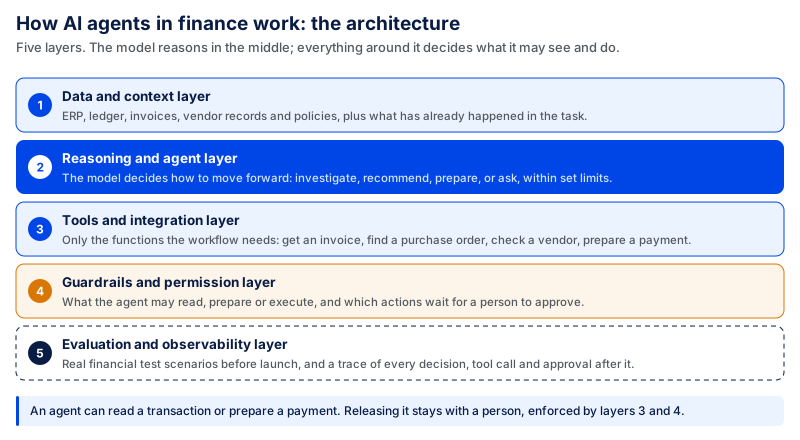
A finance agent is more than a model linked to company data. A production system needs five layers: data provides context, the agent decides what to do, tools enable the agent to act, guardrails limit what the agent can do, and evaluation checks whether the result is correct.
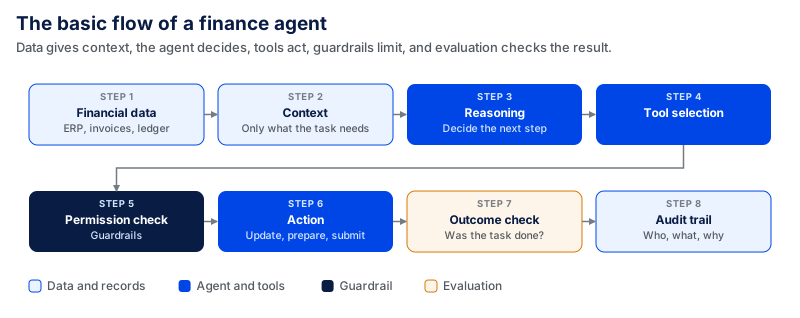
Each layer deals with a different set of issues.
Data and Context Layer
The agent must have dependable information regarding the job. This may come from an ERP, general ledger, CRM, bank feed, invoice, contract, policy document, market data provider, or previous transactions.
Context also enables the agent to remember and track previous events. So when it reconciles, it can pick up an unmatched transaction, check the ERP, find an invoice, and compare the results without losing the previous information.
The challenge is getting these systems to agree. There can be multiple systems, one with a name-based ID and another with an internal ID. There might also be variations in dates, transaction types, and account descriptions.
The agent's reasoning is unreliable when systems disagree on what is meaningful. Before adding more intelligence, data quality, data lineage, entity mapping, and access controls must be addressed first.
Reasoning and Agent Layer
After gaining context, the agent must decide what to do next.
RPA can follow a predefined sequence, whereas an agent can change the sequence while the workflow is executing. It can look at a step's output and decide what to do next based on it.
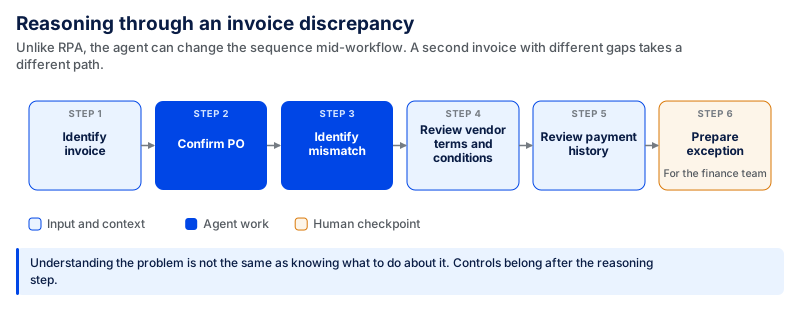
A second invoice might have to be routed along a different path as the missing information is different.
This is beneficial, but it also raises certain issues. The agent does not necessarily know what action to take, even if it understands the problem correctly. The application must therefore include controls after the reasoning step.
Tools and Integration Layer
The exact technology depends on the workflow. For example, Coding Crafts built a contract review and document analysis platform for finance workflows that combined a contract engine and payment engine with AI-assisted document analysis and anomaly detection. The system used @ai-sdk/react for AI-powered workflows and a custom document interface to help users find clauses, payment details, and potential discrepancies across large documents.
Rather than giving the agent broad access to an entire financial system, developers can expose only the functions it needs. For an invoice workflow, these might include functions to retrieve an invoice, find the related purchase order, check the vendor record, review payment history, create an exception, prepare a payment action, or send the case for approval.
The agent can then choose among these approved functions based on the task, while the surrounding system controls what each function is actually allowed to do.
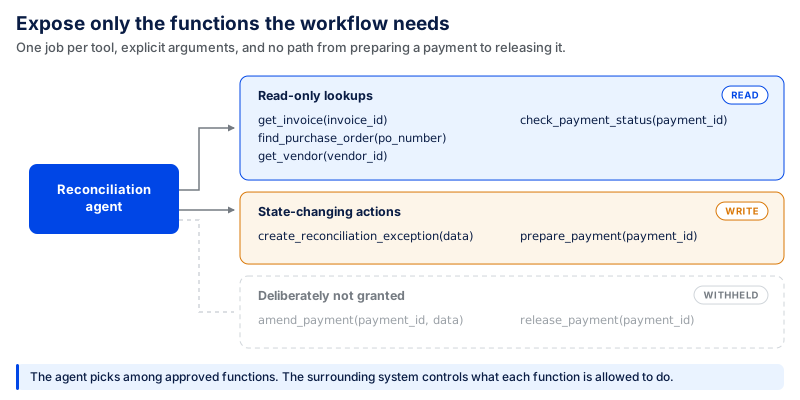
The agent uses the correct tool and supplies information according to the task. The items in this design also outline clearer boundaries. If an agent is required only to prepare a payment, it must not have the authority to also amend or release one.
Tool design is also important. The agent might pick the wrong tool if multiple tools share the same name and vague functionality. Tools should also be purposeful, have limited permissions, and use logical arguments and outputs.
Guardrails and Permission Layer
This layer defines the operations the agent can perform. In financial matters, permissions should apply to specific actions and their possible impacts, rather than granting an agent access to an entire system.
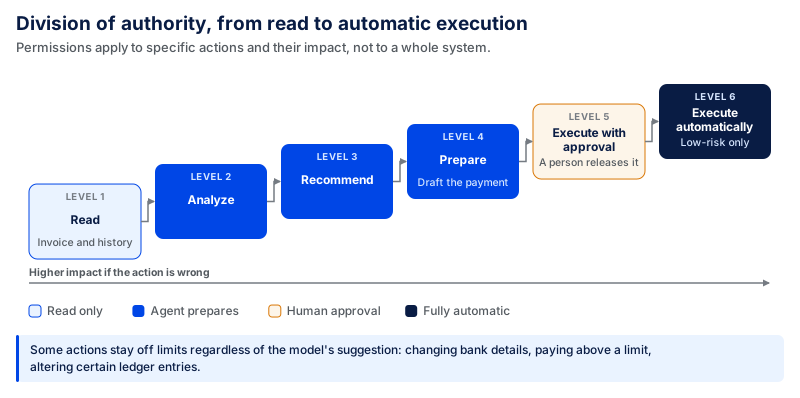
For example, an agent can read an invoice and payment history without needing separate approval for each read action, as long as it has the appropriate access permissions. It may also prepare a payment. However, the payment must first be approved by a finance manager before it is released.
Higher-risk actions can also have additional limits. An agent may not be able to alter bank information, make payments over a limit, or even alter some ledger information, despite the model's suggestion.
This is important to remember: an agent's ability to perform an action does not mean it is authorized to perform it.
Evaluation and Observability Layer
The last layer makes sure that what the agent did is what was intended. Conventional monitoring might detect the success of an API call. It's not sufficient for financial workflows. Even if the API call is successful, the amount could be incorrect, it may impact the wrong account, or it may not reconcile.
Teams should have access to the entire workflow: data access and selection, arguments passed, actions taken, human intervention, and the success or failure of the eventual goal.
Next, evaluation ought to assess both the end product and the individual processes. That may include tool-selection accuracy, calculation accuracy, reconciliation, exceptions, unauthorized action attempts, human override rates, latency, and cost, depending on the workflow.
This yields an architecture in which the model cannot be run independently. The agent can reason and act, but the surrounding system controls the data, permissions, actions, evaluation, and audit trail. In finance, that surrounding architecture turns a useful prototype into a system that can be relied upon in production.
How to Build and Deploy AI Agents in Finance
The model should come after the workflow when building a finance agent. Outline the task, required data, permitted actions, and approval points first. Next, build the agent within these limits.
Define the Financial Workflow and Use Case
Work with one particular process. Draw a map of how the task starts, which information is required, decisions that must be taken, and what the successful outcome will look like.
For instance, rather than “automate invoice processing,” specify the objective: match invoices with purchase orders, analyze invoice-purchase order mismatches, and refer unmatched invoices to AP specialists. Describe what the agent is not allowed to do, for example, changing vendor bank details, releasing payments, etc.
Connect the Required Data and Systems
Add the systems required for the workflow, such as ERP, the general ledger, the payment system, CRM, contracts, or the document repository. Don't connect them until you have checked the source data. Even a capable agent can produce the wrong result when the underlying records are incomplete, outdated, duplicated, or inconsistent.
Design Tools, Permissions, and Guardrails
Limit the tools the agent can access for the financial task. For instance, an AP agent could retrieve invoices, confirm purchase orders, confirm the vendor, prepare exceptions, and prepare payments for approval. It doesn't need access to the full range of the financial system.
The level of permission should also match the risk of each action. The agent might be able to view an invoice or even draft a payment, but if it needs to release funds, alter bank information, or edit significant financial files, there should be additional controls or human oversight.
Make sure there are firm restraints on these actions, too. Use the application and permission system to enforce transaction limits, required approvals, input validation, and access checks. A prompt can direct the agent's actions, but should not be the sole obstacle to an unauthorized financial action.
Choose the Right Level of Autonomy
Correctly pair autonomy with the risk of the action.
A useful way to set those boundaries is to define what the agent can do alone, what requires approval, and what it should never do automatically.
| Workflow | Agent may do alone | Needs human approval | Should not do automatically |
|---|---|---|---|
| FP&A | Retrieve data, compare actuals with forecasts, prepare variance analysis | Publish or act on material financial decisions | Change approved budgets or financial records |
| Accounts Payable | Read invoices, check purchase orders, investigate mismatches, prepare payments | Release payments and approve significant exceptions | Change vendor bank details without verification and approval |
| Accounts Receivable | Review payment history, identify overdue accounts, prepare reminders | Approve significant account adjustments or settlements | Make high-impact customer account changes outside defined limits |
| Reconciliation | Match records, investigate differences, prepare exceptions | Approve material adjustments | Alter source records simply to force a match |
| Fraud and Risk | Gather evidence, investigate signals, flag suspicious activity | Block payments, freeze accounts, or take other high-impact actions | Take irreversible customer action without the required evidence and authorization |
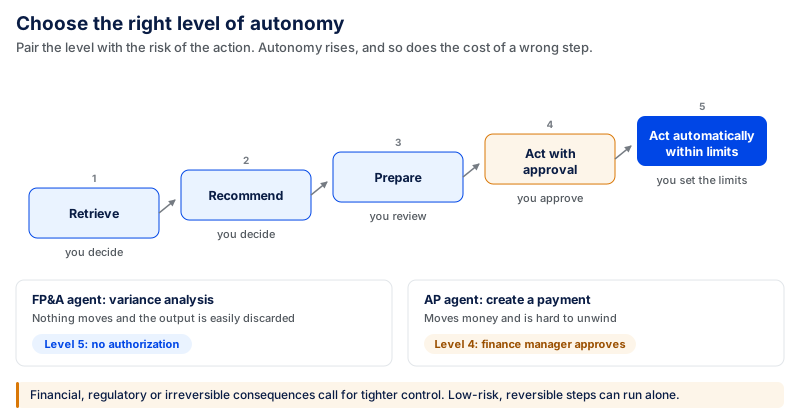
The same principle applies across these workflows: autonomy can increase for low-risk, reversible actions, while financial, regulatory, or difficult-to-reverse actions need stricter controls.
Build Evaluation and Test Against Real Financial Scenarios
Don't consider only clean pilot data. Check duplicate invoices, missing purchase orders, conflicting records, odd document formats, unusual amounts, incomplete fields, and unauthorized requests.
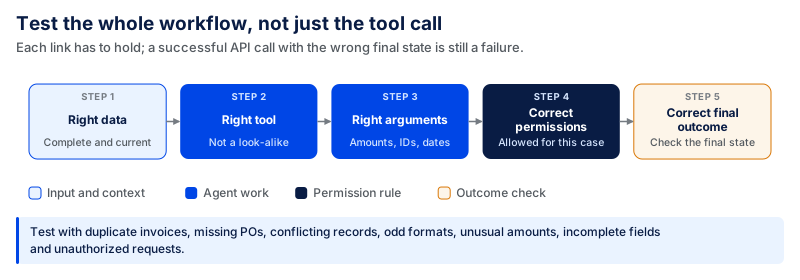
A successful API call or tool call doesn't necessarily mean that the financial task was completed properly. You also need to check the final state.
Add Human Approval Where It Matters
Do not leave people out of high-impact activities like payment releases, changes to vendor banking details, important ledger record changes, or blocking customer accounts.
Provide reviewers with enough information to make a decision: the proposed action, amount, source records, supporting evidence, and reason for the recommendation. This means human approval is a true control, not just another button in the workflow.
Deploy, Monitor, and Improve
Deployments should be done on a phase-by-phase basis. The agent can be tested in similar cases in the past and then tested in shadow mode against live workflows without the ability to perform financial actions. This provides the team with an opportunity to check their recommendations against approved outcomes prior to enhancing access.
Production access can then be slowly added back in. Any low-risk actions can be automated first, followed by high-risk actions like account changes, payment, and sensitive data changes, which will still require human approval. The team should also establish who may grant further permissions and what factors limit or diminish the agency's independence.
Also, a rollback path is crucial. When the exception rate rises or the permission check fails or the evaluation does not fall within the approved limits of the workflow, the action should be rechecked by the human operator rather than automatically continued.
This staged approach aligns with Coding Crafts' AI development process, which moves from discovery and data readiness through proof of concept, productionization, guardrails, and continuous iteration.
Build vs Buy: Which Approach Is Right for Your AI Agent?
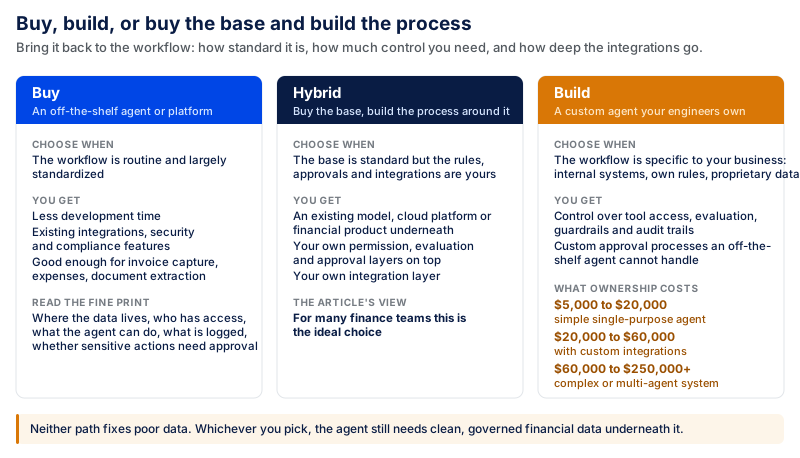
Prospective buyers need to determine whether they need to build, how much control they need over the financial workflow, and how seamlessly the solution needs to integrate with existing systems. There is no right or wrong answer.
There's a logical case for buying when the workflow is routine and largely standardized. Basic tasks like invoice capture, expense processing, document extraction, or simple customer support can be done adequately by an existing platform. Purchasing can cut development time and give teams access to existing integrations, security measures, and compliance features.
But make sure you read what the product lets you control. Finance teams need to know where the data is, who has access, what the agent can do, what gets logged, and whether sensitive actions require human approval.
It makes sense to build when there is a workflow specific to your business. Use a custom agent to implement internal systems, company-specific financial rules, proprietary data, or custom approval processes that an off-the-shelf agent may not be able to handle.
Building also gives engineering teams greater control over tool access, tool evaluation, guardrails, and audit trails. Ownership comes with a price. According to Coding Crafts' AI agent development cost estimates, a simple single-purpose agent can cost around $5,000–$20,000 to build, while an agent with custom integrations can range from $20,000–$60,000. Complex or multi-agent systems can reach $60,000–$250,000+, with enterprise agent platforms starting around $250,000. These are development estimates rather than finance-specific fixed prices, and ongoing model usage, hosting, observability, and evaluation add separate operating costs.
There is a middle ground: buy the base and build the process around it. The company can implement layers of permission, evaluation, and approval on top of an existing model, cloud platform, or financial product as it builds its own integration layer.
Poor data is one issue that neither approach immediately fixes. Buying or building the agent does not remove the need to clean and govern the financial data it relies on.
It's better to bring it back to the workflow. Purchase if the process is standardized and a product already fulfills your control requirements. Build when the process, data, integrations, or permissions require deep customization. For many financial teams, a hybrid solution is the ideal choice.
Understanding The Limitations of AI Agents in Finance
Agents can handle complicated financial processes, but they can also create risks that don't occur in conventional automation. They can apply incomplete information, choose between tools, and decide what to do next. Limitations in finance can impact payments, reporting, customers, and compliance – and must be resolved prior to production.
Incorrect Financial Outputs
An agent may generate a response that seems sensible and sound but isn't financially correct. It could miss the point of a document, cross-reference the wrong transaction, rely on incorrect information, perform an incorrect calculation, or even provide an incorrect recommendation.
Another challenge is that each individual step can be correct, and the final step still incorrect. A reconciliation agent may be able to obtain the correct files and run all of the steps correctly, but find the wrong records in the files and cause the ledger to be incorrect. Teams should therefore look at the overall financial outcome, rather than just at successful model responses or tool calls.
Data Privacy and Security
Finance agents often need access to sensitive data such as transaction data, account details, invoices, contract data, customer data, and financial reports.
Increasing the level of access granted to an agent allows more harm if an account is compromised, a prompt is injected, a configuration is misused, or a tool is called unexpectedly. Access should be restricted to the data needed to accomplish the task, and sensitive data should not be automatically stored in prompts, logs, or long-term memory.
The same goes for credentials: an agent should not automatically inherit the same broad access as an employee or administrator. Credentials and permissions should be limited to what the task actually requires.
Regulatory and Compliance Risk
Financial processes may have privacy, record-keeping, financial controls, consumer protection, and auditability requirements. Automating a process doesn't take away those responsibilities.
If an agent is part of a payment process, for instance, it may require approval records and a history of all steps taken. A fraud or compliance system may require documentation of the information reviewed and where manual review took place. Compliance needs to be considered as part of the workflow, not as an add-on feature once the agent is deployed.
Excessive Autonomy and Unauthorized Actions
The risk seems to be greatest when an agent shifts from information to action. The consequences of reading an account balance differ from preparing a payment, releasing a payment, and changing bank details. When you assign the same permission level to all these actions, you create risk that doesn't need to exist.
Autonomy should increase as the system proves it can handle an action reliably, and decrease as the action's risk increases. High-risk or hard-to-reverse actions should have set limits, stricter permissions, or human approval. An agent's capacity to do something does not imply authority to do it.
Integration and Data Quality Issues
The agent's reliability is directly tied to the reliability of the systems and information it relies on. Financial systems typically feature multiple ERP schemas, multiple vendor records, mismatched transaction IDs, inconsistent data, multiple spreadsheets, and isolated systems.
These problems are more evident during AP/AR and reconciliation. A clean pilot can turn out well because it's based on well-crafted data, but production reveals the long tail of missing fields, unexpected invoices, conflicting data, and regional variations.
Even a better model does not solve this issue. Teams need access to a trusted source of truth, data ownership, and a standardized method for identifying financial entities across systems.
Explainability and Auditability
It isn't enough for finance teams to simply get the answer. They may need to know what information the agent used, what tools it invoked, what decisions it made, what it changed, and who approved the action.
A basic API log can't provide that level of detail. Production systems must be able to trace the results from the original request to the retrieved data, tool use, approvals, and outcomes.
This becomes especially important when problems occur. The team should be able to follow the process when a transaction is incorrect, a transaction is incorrectly blocked, or a reconciliation changes unexpectedly, and see where the failure occurred.
The above limitations do not mean that finance agents should have no autonomy. They show that autonomy needs clear boundaries. Reliable financial agents will include features such as sound decision-making, trusted data, restricted access, checks and balances on outcomes, human oversight, and a transparent audit trail.
Where Agentic AI in Finance Is Heading
In the financial sector, Agentic AI is evolving from a question-answering assistant to systems that can monitor financial processes, investigate issues, and complete multi-step workflows across several systems.
The change from point-in-time checks to continuous monitoring will be a key one. For fraud and risk, agents can continually correlate transaction activity, identity information, device signals, sanctions data, and more to uncover new risks as they emerge. This matters because fraud techniques continue to evolve and can be difficult to address with static rules alone.
There will also be increased end-to-end finance operations. An agent can maintain task context and choose which automated tool to use at each step of invoice extraction, matching, exception handling, and payment preparation.
The more responsibility and authority these systems have, the more action-specific authorization they will require. Reading an account, reviewing a transaction, changing a record, and releasing funds shouldn't all have the same level of authorization. Irreversible or high-impact actions will need stricter controls, with higher evidence thresholds and human approval.
Also, instead of assessing whether the model produced a correct response, evaluation will expand beyond the model itself. Teams will have to assess whether the agent used the right tools, had the right data, adhered to permissions, handled exceptions appropriately, and achieved the desired financial goal.
Model ability might not be the greatest limitation. Capable agents may be unable to work effectively if ERP data is fragmented, entities are inconsistently defined, systems are not properly integrated, and the audit trail is ineffective. Therefore, beyond improving the models, the next step in adoption will depend on data architecture, permissions, model observability, and financial controls.
Build Production-Ready AI Agents for Finance With Coding Crafts
Building reliable finance agents involves more than linking a model to financial data. Coding Crafts enables teams to build agentic workflows from the ground up, with secure system integrations, scoped permissions, human approvals, real-world testing, and monitoring.
One example is an AI-powered financing platform Coding Crafts built for small-business financing workflows. The system used role-based AI for merchants, funders, and sales representatives, while negotiation rules set limits on rates, terms, and loan amounts and escalated cases to a human representative when needed. During trial usage, time to next action dropped from 48 hours to around 18–24 hours, application completion improved by approximately 8–15%, and failed payment attempts decreased from 3–6% to 1–2%.
The project shows the same principle discussed throughout this guide: useful automation comes from combining AI with business rules, controlled access, workflow state, and clear escalation points rather than giving a model unrestricted authority.
Ready to build AI agents for finance? Talk to Coding Crafts
Finance agents that never release a payment alone
Coding Crafts designs the tool permissions, approval gates and evaluation sets first, then connects the agent to your ERP and ledger.
More from the blog.
View all postsRelated reading from the Coding Crafts team.