Proof of Concept vs Prototype: Which One Does Your Project Need?
Teams do not have to build a full product to test an idea. They can first test the technology, review the user experience, or release a basic working version to real users.
Each option answers a different question. One checks whether the idea works technically. Another shows how people would interact with the product. A working early version tests the core product with real users.
The main uncertainty determines which stage comes first. This guide compares proof of concept, prototype, and MVP by purpose, cost, timeline, and pass or fail criteria.
What Is a Proof of Concept?
A proof of concept tests whether an important technical idea works before the team builds the full product. It answers one specific technical question that could stop or significantly change development.
For example, a PoC can test whether an AI model reaches the target accuracy, an existing system processes 400 writes per second, or an external API provides the required product data.
The team sets a measurable pass condition before testing. An AI model could require at least 90% accuracy. A system could require 400 writes per second under a defined load. The result shows whether the proposed technical approach meets that condition.
The output can be a script, notebook, benchmark, throughput report, or experimental code branch. A PoC does not require a complete interface, production infrastructure, detailed error handling, or polished user flows.
If the test meets the pass condition, the team has evidence to continue with the proposed approach. A failed test gives the team a reason to change the technology or technical design before spending more on development.
What Is a Prototype?
A prototype shows how users will interact with the planned product. It helps the team check screens, navigation, workflows, and important interactions before full development.
The technical approach is usually clear at this point. The main question is whether the planned product experience makes sense to users.
Users can click through screens and complete a planned workflow without a working backend. Simple wireframes help review navigation. Detailed screens help assess specific interactions.
A low-fidelity version uses sketches, wireframes, or simple grey boxes to check structure, navigation, and workflow order. A high-fidelity prototype looks closer to the planned product and helps the team check whether users can complete important tasks.
The design should only have the detail required for the test. Simple wireframes are enough when you only want to check whether users understand the workflow.
Dropbox is a useful example. On April 4, 2007, Drew Houston posted a Dropbox demo on Hacker News titled “My YC app: Dropbox - Throw away your USB drive.” The video showed how Dropbox would sync files. People shared feedback about folders, offline access, and pricing. The Dropbox demo is often described as an MVP, but it also shows how a prototype can collect feedback before development.
Understanding an MVP
An MVP is the first working version of a product released to real users. It delivers the main function and collects data from actual use. It shows whether users complete the main task, return to the product, pay for it, and use its features.
Unlike a prototype, the MVP lets users complete real tasks in a working product. Our MVP development guide explains how to build this version. The Coding Crafts software product development guide explains the complete process from planning to launch and future updates.
PoC vs Prototype vs MVP: What's the Difference?
| Proof of Concept | Prototype | MVP | |
|---|---|---|---|
| Main question | Can this be built? | How should it look and work? | Will real users use it? |
| Audience | Engineers and technical decision-makers | Users, designers, and product teams | Real customers or users |
| Output | Benchmark, script, or measured result | Clickable user flow | Working product |
| Leaves out | Complete interface, production scale, and full error handling | Production code, live data, and complete backend functions | Features outside the core workflow |
| Typical duration | Several days to 2–3 weeks | 1–5 weeks | 2–6+ months |
| Typical cost | Around $5,000 to $20,000+ | Around $3,000 to $15,000+ | Around $20,000–$30,000 to $100,000+ |
| Pass condition | Meets the agreed technical threshold | Users complete the specified task | Meets the agreed usage, revenue, or retention target |
The cost and duration estimates come from SolveIt’s May 2026 figures. They do not represent Coding Crafts pricing.
What Each Stage Should Deliver
Each stage should produce a clear result. Agree on the expected deliverables before work starts so the team and client know what they will receive.
Proof of Concept
A proof of concept should include the technical work and results from the test. This can include experimental code, benchmark results, performance data, and technical findings.
The final result should state whether the technical approach met the agreed pass condition. It should also document any technical problems found during the work.
Prototype
A prototype should include the screens and user flow selected for the test. The team can deliver wireframes, clickable screens, user feedback, and changes made after the test.
The results should identify where users completed the task and where they had problems. The team can fix these issues before development.
MVP
An MVP should give real users access to the core product features. The team should also track the results selected before release.
These results can include completed tasks, repeat use, conversions, or purchases. The data helps the team decide what to change or build next.
Set the Pass Condition Before You Start
Decide what counts as a successful result before starting the work. Write it in a simple go/no-go sheet so the team knows exactly what it has to achieve:
| Proof of Concept | Prototype | MVP | |
|---|---|---|---|
| Question to answer | Does the technical approach work? | Do users understand the proposed flow? | Do real users complete the core task? |
| Expected result | Technical test result | Tested product flow | Working core product |
| Pass condition | Meets the defined technical threshold | At least 8 of 10 test users complete the main flow without help | At least 70% of test users complete the core task successfully |
| Person who approves it | Technical lead | Product lead | Product owner |
The expected result should be specific. Examples include a benchmark number, throughput report, recorded user session, or completed user flow.
The pass condition should have a measurable threshold. Avoid statements such as “stakeholders are happy” because they do not state what result counts as success.
This sheet gives the team and client a clear finish line. Everyone knows what the stage should produce before work begins.
How to Set a Pass Condition
A pass condition should have four parts. Choose a measurable result and set the threshold before work starts. For example, set a specific accuracy level for an AI model, a transaction rate for a system, or a task completion target for a prototype.
State what counts as failure so the team knows when to change or stop the current approach. Do not change the threshold after seeing the result because this changes the original success criteria.
Assign one person to approve the result. A technical lead can approve a proof of concept, a product lead can approve a prototype, and the product owner can approve an MVP.
Also decide what happens after failure. The team can change the target, try another technical approach, or stop that part of the project.
How Much Do a Proof of Concept, Prototype, and MVP Cost?
The cost depends on the project scope, team, and work involved. SolveIt published the following estimates in May 2026:
- Proof of concept: approximately $5,000 to more than $20,000 for several days to 2–3 weeks of work.
- Prototype: approximately $3,000 to $15,000+ for 1–5 weeks of work.
- MVP: approximately $20,000–$30,000 to more than $100,000 for 2–6 months or longer.
These figures come from SolveIt and do not represent standard market or Coding Crafts prices.
Design software creates a separate expense for prototypes. Railsware's July 2026 breakdown lists Figma plans from $12 to $75 per editor per month. This cost is small compared with the development work.
Labor makes up most of the project cost. Engineers spend more hours when they have to investigate an unfamiliar API, work with an older system, or prepare data for an experiment.
Scope changes also increase development hours. Changing the main question or pass condition after work starts can result in repeated work or additional tasks.
Ask for the estimated tasks, hours, roles, and rates instead of one total price. This shows how the team calculated the estimate and which parts of the project cost the most.
For larger projects, our custom software development cost guide explains full development budgets. Our cost estimation guide explains project estimates, and our AI app development cost guide explains costs for products built around AI.
What Happens When You Skip Validation?
Building a product before checking customer demand can lead to expensive mistakes. Juicero shows what can happen when a company builds a product before checking whether customers actually need it. The company raised more than $118 million and developed a Wi-Fi-connected juice press that originally sold for $700.
In 2017, reports showed that people could squeeze the juice packets by hand without using the machine. Juicero shut down on September 1, 2017.
The machine worked as designed, but customers did not need it to squeeze the packets. A technical proof of concept would not have solved this problem because the main question was about customer demand.
Building before checking an important assumption can waste time and money. A team can invest in design, backend development, integrations, infrastructure, and launch work before finding out that customers do not want the product.
Check the main uncertainty first. Test technical questions with a proof of concept, user flows with a prototype, and customer demand with an MVP.
When You Can Skip These Stages
Some projects can move directly into development without a proof of concept, prototype, or MVP. A separate technical test is unnecessary when the team has already solved the same problem using familiar technology.
A design test is also unnecessary when the workflow and interface are already clear. For example, a simple internal application with standard forms, lists, and reports can move directly into development.
Consider the cost of validation as well. Spending two weeks testing the design makes little sense when the complete product takes four weeks to build.
Existing products can test changes with current users or release a new feature to a small group first. This gives the team feedback without creating a separate validation stage.
Compare the cost of validation with the cost of fixing a wrong decision. Direct development makes more sense when fixing the problem costs less than running a separate validation stage.
How to Choose the Correct Stage For Your Next Project
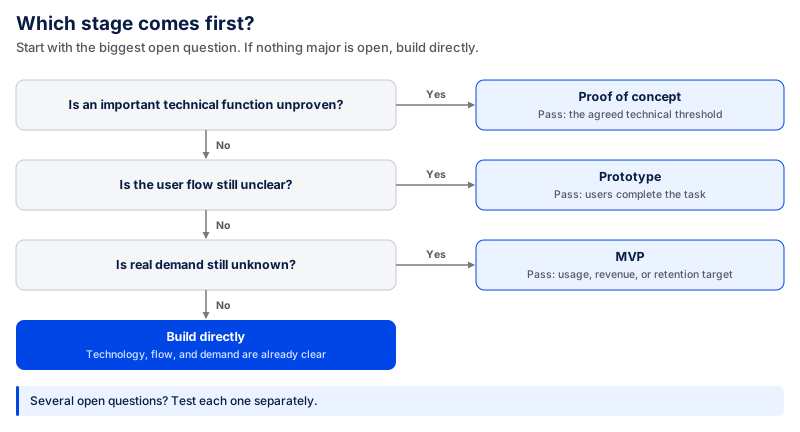
Choose the stage according to the question you still have to answer. Check whether the uncertainty is technical, related to the user flow, or about real customer demand. If these areas are already clear, you can move directly into development.
Technical Feasibility
A proof of concept works when an important technical function is still unproven. Test one question such as AI model accuracy, API limits, system performance, or an integration.
Set the pass condition before work starts. Measure the result through an accuracy score, response time, throughput rate, or completed integration.
User Flow
A prototype helps when the technology is clear but the user flow still needs validation. Check the navigation, screen order, task completion, and main interactions.
Test it with target users. Record where they complete the task, hesitate, make mistakes, or get stuck.
Real User Behavior
An MVP gives you data from real product use. Release the core features to real users and track what they do.
Measure task completion, activation, repeat use, conversions, or purchases. Set the expected result before release and compare it with the actual data.
No Major Uncertainty
Move directly into development when the technology, user flow, and customer demand are already clear. A separate validation stage adds time and cost without answering a new question.
Compare the validation cost with the cost of fixing a wrong assumption. For a small product, fixing the problem during development can cost less than running a separate validation stage. If the project has several unanswered questions, test each one separately.
Build Your Software With Coding Crafts
Coding Crafts builds custom software from early validation through full development. Our development rates range from $25 to $49 per hour, depending on the project scope and team.
Start with our 40-hour no-obligation trial to work with the team before making a longer commitment. If you are not satisfied with the trial, you owe nothing.
Frequently Asked Questions
Is an MVP the same as a prototype?
No. A prototype shows how the product will work for users. An MVP is a working product that real users can use and give feedback on.
Can you skip a proof of concept?
Yes. Skip it when the technical approach already works and there are no major questions to answer before development.
How long does a proof of concept take?
A proof of concept can take several days to two or three weeks. Complex technical work can take longer.
Who builds a proof of concept?
Engineers usually build a proof of concept to check whether the technology works. Designers usually create prototypes to check interfaces and user flows.
What happens if a proof of concept fails?
The result did not meet the target. The team can change the target, try another approach, or stop that part of the project.
Do investors want a prototype or an MVP?
They serve different purposes. A prototype presents the planned product experience, and an MVP collects data from real users.
How much does a prototype cost?
Prototype development costs around $3,000 to $15,000 or more. The final cost depends on the scope and level of detail.
From idea to evidence, fast
Coding Crafts builds PoCs, prototypes, and MVPs in weeks, not quarters: senior engineers at $25 to $49 per hour who tell you honestly what the evidence says.
More from the blog.
View all postsRelated reading from the Coding Crafts team.