Krypton: Real-Time Blockchain
Innovative blockchain infrastructure addressing ETL challenges in crypto and NFT sectors. Built on Ethereum, Krypton demystifies smart contracts, wallet actions, and transactions while providing complete blockchain history for informed decision-making.
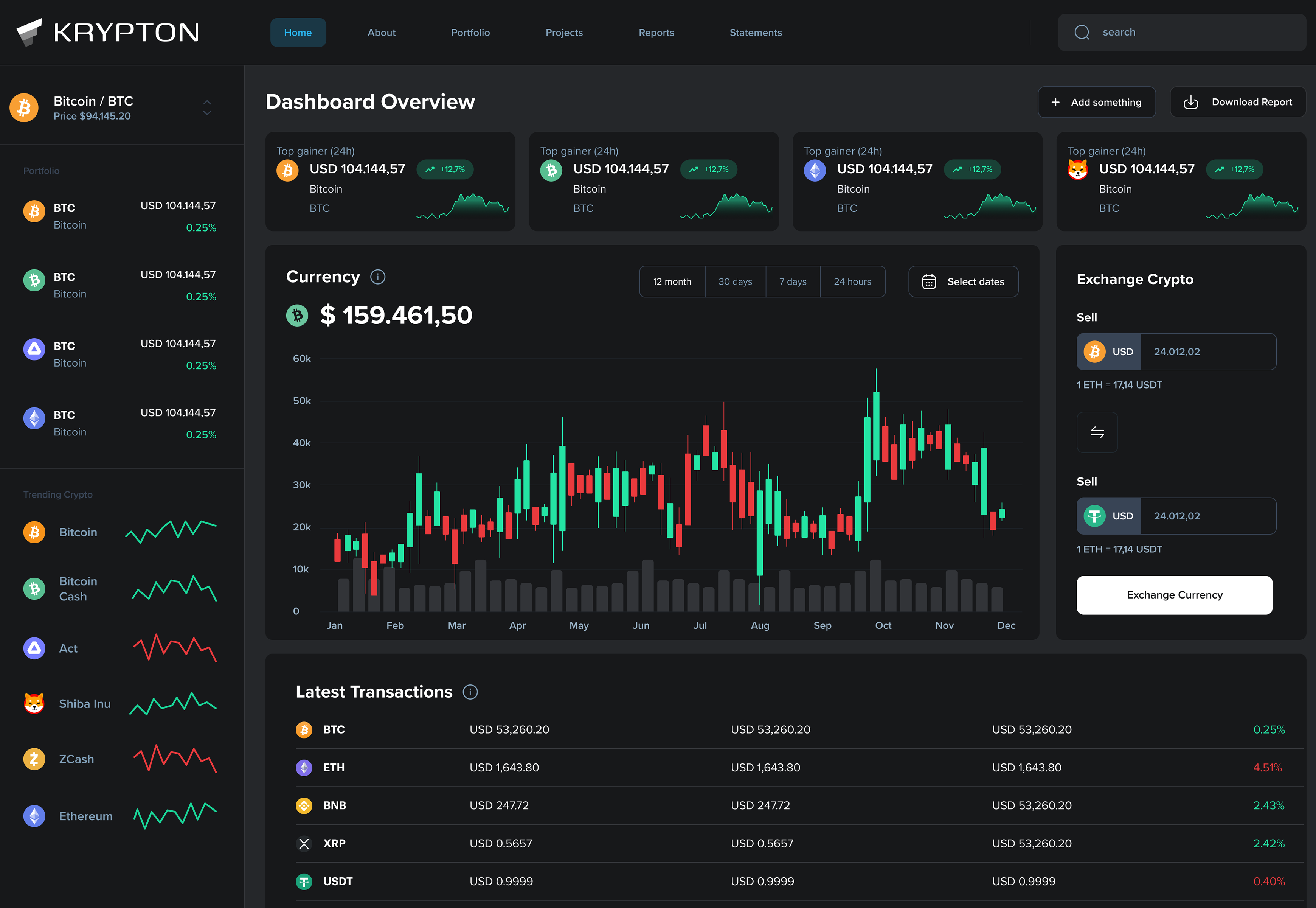
Krypton: real-time blockchain data infrastructure
Krypton is an innovative blockchain infrastructure developed by Coding Crafts to address the intricate ETL problems in the crypto and NFT segments.
Taking its cues from the Ethereum blockchain, Krypton enables users to demystify smart contract occurrences, wallet actions, and transactions, and provide total blockchain history.
This versatile tool furnishes decision-makers with accurate and timely information in the constantly evolving blockchain landscape.
The vision: live insight into Ethereum activity
The primary objective was to create a robust system capable of delivering real-time insight into Ethereum based transactions and other blockchain happenings.
A key objective was to provide an opportunity to conduct a detailed historical analysis of the cited blockchain parameters, and to improve decision-making processes was also a key goal.
Furthermore, the project aimed at creating an easy-to-navigate application that interfaces well with other blockchain utilities. It also focused on the scalability aspect of the project due to the ever-increasing data in the blockchain field.
Taming node sync and blockchain ETL
Developing Krypton required overcoming several technical and operational challenges. Regarding blockchain node setup and synchronization, creating a consistency factor was an essential step in Ethereum, keeping the multiple nodes in the blockchain within the network synchronized for data integrity and accessibility.
his entailed configuring the consensus and execution clients and avoiding delays in accessing data. Their coordination is shown below, as the consensus and execution clients have to be configured so that there isn’t necessarily a large delay when accessing data.
In terms of real-time data management, there was a requirement to monitor the huge inflow of blockchain transactions in real time. One of the most notable challenges is manipulating reorganized blocks and maintaining data integrity during block changes.
For the mediated use of data regarding organization and retrieval, superimposing the blockchain to enable real-time, fast queries was critical for analysis.
For this purpose, the team used Astra DB for high performance, flexible storage, and retrieval as the data size increased. Finally, concerning technical resilience and robotics, it was necessary to ensure that the infrastructure for such a scheme allowed for constant data processing with minute interruptions and as little intervention as possible. Simplification became key when setting up and the synchronization steps involved.
How we solved it: a scalable real-time pipeline
To address these challenges, Coding Crafts developed a suite of solutions that transformed Krypton into a scalable and efficient platform. For fine-tuning blockchain nodes, the team used Geth and Prysm clients to guarantee that the Ethereum blockchain operated in a coordinated way.
This configuration also enabled the extraction of extra data from the blockchain for further analysis. Through advanced queue management, the active queues system was then developed to support the constant flow of data expected from the blockchain.
It ensured that there were few or no stopovers in the processing of transactions within this system. Regarding behavioral analytics of blockchain events, sophisticated mathematical models analyzed blockchain activities, including smart contract actions and block re shelving.
This gave some information about blockchain events and also improved the system. To enable automation with Terraform, the team was able to automate the creation of this infrastructure and data replication through the assistance of Terraform. This reduced manual overhead and also simplified the incorporation of additional new data sources.
The stack: TypeScript end to end
The Krypton platform was built using a modern and efficient tech stack, including: Programming Languages using JavaScript/TypeScript for robust development; a Frontend utilizing Next.js and MUI for a responsive and user-friendly interface; and a Backend using Node.js for scalable backend services, TypeORM for database interactions, and Redis with BullMQ for queuing mechanisms.
Blockchain Integration utilized Geth and Prysm clients for Ethereum, with support from Erigon nodes for additional blockchain analytics. Database and Indexing relied on Astra DB to manage and retrieve indexed blockchain data efficiently.
Monitoring and AI Integration used Bugsnag for error monitoring and OpenAI for advanced analytics. Finally, Infrastructure Tools included Terraform for rapid and automated infrastructure management.
The outcome: smart contracts made legible
The final product exceeded expectations, delivering a state-of-the-art blockchain platform with several key features. Through real-time insights, Krypton allows the user to view fresh data from the Ethereum blockchain, such as the transaction history and the specifics of smart contract events.
It utilizes a scalable infrastructure where the backend of Cosmic JS, built on Node.js and Astra DB, guarantees reliability when scaling up the dataset. Broad blockchain inspection allows sophisticated mathematical computations to enable users to analyze variabilities in blockchain behaviors to improve transparency and decision-making. Offering a user-friendly experience, as an embedded blockchain application, Krypton makes working with large sets of blockchain data easier through a minimalist interface built with Next.js and MUI.
Finally, automation and resilience are ensured as Terraform stabilizes infrastructure through automation, and there are real-time update installations due to the queue system.
Krypton is a good example of Coding Crafts’ competence in creating blockchain services. It shows how issues like data sync, online data processing, and maintaining the system’s extensibility can be solved with purposeful thinking and the right tools at hand. The platform has become an invaluable tool for users in the crypto and NFT spaces, allowing them to work comfortably within the blockchain context.
Let's build the next one.
Have a project like this? Tell us what you're building. A real person reads every message and replies within one business day.