Why Web Development Is Important for Your Brand Presence

Your website is where most people will meet your business first. If that site loads slowly, looks broken on a phone, or won't show the contact form, they leave before they learn what you're all about.

This happens much more often than business owners anticipate. The HTTP Archive's 2025 Web Almanac, which analyzes real Chrome user data rather than lab tests, found that only 48% of mobile websites and 56% of desktop websites met Google's Core Web Vitals thresholds in July 2025. On mobile, about one in two sites doesn't meet a basic benchmark for loading, responsiveness, and visual stability.
This is why web development matters for your business. It affects your website's performance, functionality, and appearance. A well-developed site will be responsive, cross-platform, uphold the brand, and make it easy for customers to contact you, schedule an appointment, or place an order.
The same is true for online discovery for your business. If your website is user-friendly, fast, and well-organized, search engines can understand your pages. The same technical underpinnings are becoming increasingly relevant as people use AI-powered search and answer services to seek out information.
In this guide, we'll explain why web development matters for your brand, from first impressions and mobile experience to search visibility and conversions. We'll also show you how to review your website and identify areas that need improvement.
Quick Summary: Why Is Web Development Important?
Web development affects how people see, use, and find your website. Here is a quick look at why it matters for your business.
| Area | Why It Matters |
|---|---|
| First impressions | A fast and easy-to-use website creates a better first experience with your brand. |
| Brand consistency | A well-built website keeps your colors, fonts, buttons, forms, and other elements consistent. |
| Mobile experience | Responsive development helps your website work properly on phones, tablets, and desktops. |
| Search and AI visibility | Clear site structure and technical setup help search engines and AI-powered tools understand your content. |
| Conversions | Good development makes forms, bookings, purchases, and other important actions easier to complete. |
| Competition | A better website experience helps your business meet customers' expectations online. |
These areas show that web development is more than building pages. It affects how your website supports your brand and helps people interact with your business.
What Does Web Development Actually Cover?
Web development is all the technical aspects of building a website. It includes the components visitors can see and use, plus the systems that run behind the scenes.
Front-end development includes everything that users interact with on the website, including pages, menus, buttons, forms, and more. Back-end development covers the databases, servers, APIs, and logic behind them.
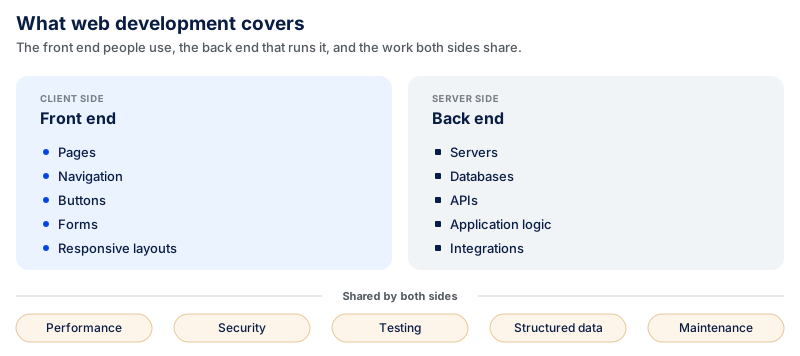
Other aspects of web development include website speed, security, integrations, structured data, testing, and website maintenance after launch. These areas all have an impact on how well a website functions for its users and search engines.
It's also different from web design. Design deals with how a site looks to the user and how users navigate. Development translates that design into a real site and integrates it with your business systems.
For any business, the two have to go hand in hand. A page can look good and still be a bad experience if it loads slowly, if it is not easy to use, or if it has broken features.
Why Web Development Is Important for Your Business
A business website is not just a place to display information about your business. It creates the impression of your brand, makes you easily discoverable online, and influences what people do once they land on your website.
Here are six reasons good web development matters.
1. First Impressions Depend on Design and Performance
For many customers, your website is the first thing they see of your business. This initial visit can set the tone for the rest of the experience.
Slow-loading pages, misaligned layouts, oversized images, and confusing navigation can be frustrating. Good website development alleviates these problems. It maintains fast page speed, stable layouts, and user-friendly functionality.
Google uses Core Web Vitals to measure website performance. For a good user experience, Google recommends that the main content loads within 2.5 seconds, interactions respond within 200 milliseconds, and pages keep a Cumulative Layout Shift (CLS) score of 0.1 or less. Google suggests measuring these at the 75th percentile of page loads, meaning a site meets the target only when most visits meet it, not just the fastest ones.
These numbers let you measure performance instead of just saying a website is fast. You can test your pages with Google PageSpeed Insights and see which areas need work.
2. Brand Consistency Builds Trust
Your website is an important part of your brand. Colors, fonts, buttons, forms, navigation, and page layouts should remain consistent throughout pages.
This is difficult to maintain on a larger website. One page uses a different type of button. Another has other headings or a different form layout. Even small differences can create a sense of disconnection.
Web developers solve this with reusable components and design systems. The team creates one version of an element and applies it in all places it appears.
You can test your own site by opening the three most crucial pages at once, typically your home page, one of your main service or product pages, and the contact or booking page. If they look and behave differently for no reason, your website lacks a consistent system. Good development takes your brand guidelines and brings them to life throughout the website.
3. Responsive Development Creates a Better Mobile Experience
Your website needs to work well on more than a desktop computer.
According to StatCounter's worldwide platform data, mobile devices accounted for 50.13% of web usage in August 2026, against 49.87% for desktop. That means a poor mobile experience can affect half of your audience.
Responsive development is when a website adjusts to different screen sizes. Text should be readable, buttons should be easily clickable, images should be scaled appropriately, and forms should be easily used without scrolling horizontally or zooming in.
Mobile performance is another thing that developers need to consider. A fast-loading page on a quick office connection can behave very differently on a slow phone connection, as the same images and scripts take much longer to load.
Test your key pages on real phones rather than only resizing a browser window. The mobile experience needs improvement when something important is difficult to do on the smaller screen.
4. Web Development Improves Search and AI Visibility
AI-powered search is another incentive to keep your website clean and easy to navigate. Businesses don't need to redesign their website to suit another set of “AI SEO” guidelines.
Google's AI optimization guidance says existing SEO best practices remain relevant because its generative AI features are rooted in Google's core Search ranking and quality systems.
Google's guidance for AI features in Search also explains that, to be eligible to appear as a supporting link in AI Overviews or AI Mode, a page must be indexed and eligible to appear in Google Search with a snippet.
In practice, the same basics apply. A page must have a clear purpose, good headings, readable text that is in HTML, useful links, and sensible formatting. Where structured data applies, it must align with the page content people will see.
There is a real limitation here. Adding schema or changing your HTML does not guarantee that an AI assistant will cite your website. Search and AI systems decide what gets used, and they do so based on many factors you can't control. The goal is simpler: make your content technically accessible and readable for both machines and people.
Web Development for Search Visibility
Search engines need to find your pages, crawl them, and understand what they are about before they can show them in search. Web development helps through site structure, crawlable links, sensible URLs, semantic HTML, sitemaps, page speed, and well-structured metadata.
Google's SEO guide for developers recommends that each page should be accessible via a link that a crawler can follow, and that semantic HTML be used if at all possible. It also stresses that text content needs to be in the DOM, which is where JavaScript-heavy sites can run into problems.
Structured data can provide more information about what a page contains. For example, the right markup can help describe a product, organization, article, event, or other type of content.
Google explains that structured data gives explicit clues about the meaning of a page, and that supplying the required properties can make a page eligible to appear in search with an enhanced display.
Eligibility is not a guarantee. Structured data does not directly improve rankings, and it does not guarantee rich results. It enables search engines to display your information in a more structured way if they decide to.
How to Check Whether Your Site Is Easy to Understand
Start with Google Search Console to check whether Google can find and index your important pages, and use its URL Inspection tool to see how Google views a specific page.
If you are using structured data, use Google's Rich Results Test to check for errors in supported markup.
These checks will not tell you if an AI tool will mention your brand. They will inform you if your website is having technical issues that are making it difficult for search systems to access and understand the site.
5. Websites Convert, Not Just Impress
A business website should provide something for visitors.
This can include asking for a quote, booking an appointment, signing up for a webinar, buying a product, opening an account, or contacting your sales team.
Development is what makes those actions work.
A lead form has to deliver information to your CRM. A booking page must communicate with a scheduling system. For an online store, you need functionality to take payments, confirm orders, and update stock.
When any of those break, a well-designed page still loses the sale. The visitor was ready to act, but the technology didn't work.
That loss is quantifiable in e-commerce. Baymard Institute, which has benchmarked the checkout flows of 344 top-grossing US and EU e-commerce sites, finds that the average site has 32 improvements to make in its checkout and estimates a potential conversion increase of around 35% from fixing them. These are usability and implementation issues, not design preferences.
That's why conversion isn't just a design or marketing issue. Developers create the forms, integrations, workflows, and technical steps that enable visitors to take action.
The same work also affects what it costs to maintain those flows. We created a single reusable form architecture for a document-processing application at Coding Crafts, rather than re-implementing the same validation and submission logic for each workflow. It saved an estimated 40–50% of the front-end form code and cut the work needed every time the form changed. That is a development-efficiency result, not a conversion result, but it is why the form behaves the same everywhere it appears, and working, consistent forms are the foundation of conversion.
6. Better Web Development Helps You Compete
Your customers don't judge your website only against companies in your field. They compare it with every other site they visit that day. That doesn't mean that every business requires a complicated or costly website. It means the essentials have to work.
Open two or three competitor sites next to your site and go through the action you want your visitors to do. Is it simpler to reach, book, sign up, or buy from your site, or their site?
That comparison typically reveals your website's shortcomings quicker than any report can.
Good web development will not make a business successful on its own. But it provides a better foundation for marketing, content, sales, and brand.
When Custom Web Development Isn't Worth It
Custom development isn't a solution for every company, and it's important to be honest about where the money goes.
If your website consists of a few pages telling people what you do and how they can contact you, and it loads fast, and works on a mobile phone, then a website builder and a good template is generally sufficient. The cost of custom development to duplicate features already well done in a template isn't worth paying for.
The same goes for timing. If traffic is the main problem, a rebuild will not solve it. However, if a particular area is broken, like the contact form or a slow product page, it's more economical and easier to fix that component than to begin again.
Custom development is worth the cost when the website needs to do something a template can't: connect to your internal systems, support customer accounts, process custom booking or payment flows, manage a large or complex catalog, or meet security and compliance requirements. If none of that applies, spend the budget elsewhere.
Website Development Self-Audit Checklist
You can identify common website issues without being a developer. Select three significant pages on your website, including your homepage, service page, and contact or booking page. Check them against the points below.
| Check | Pass | Needs Work |
|---|---|---|
| Page speed | Main content loads within 2.5 seconds | Main content takes longer than 2.5 seconds to load |
| Mobile use | Text, menus, buttons, and forms work properly on a phone | You need to zoom, scroll sideways, or struggle to tap elements |
| Navigation | Important pages are easy to find | Visitors have to search through several menus or pages |
| Brand consistency | Fonts, colors, buttons, and layouts stay consistent | The design changes without a clear reason from page to page |
| Forms and actions | Forms, booking buttons, checkout, and other main actions work | A form fails, a button leads nowhere, or an action is confusing |
| Search access | Important pages can be found and indexed by Google | Important pages are blocked, missing, or not indexed |
| Structured data | Relevant markup is valid and matches the page content | Markup contains errors or does not match what visitors see |
| Broken links | Important internal and external links open correctly | Visitors reach missing pages or broken links |
| Security | The site uses HTTPS and browsers show no security warning | Visitors see a security or certificate warning |
Three of these checks can be run with the tools linked earlier in this guide: PageSpeed Insights for speed, Search Console for indexing, and the Rich Results Test for markup. Google treats a Largest Contentful Paint of 2.5 seconds or less as good, and recommends evaluating Core Web Vitals at the 75th percentile of page loads. Evaluate results based on the experience of most visitors, not a single test run.
If your site doesn't pass all the checks, don't worry. Consider issues that impact customers first. Fix a broken contact form before a minor change to button styles. A very slow checkout page matters more than a small glitch on a page many people don't use.
Repeat the process after you make changes. You'll get a clear before-and-after instead of guessing whether the work improved the site.
How Much Does Professional Web Development Cost?
Web development costs can vary a lot. A small business website and a custom web application require very different amounts of work.
In its published guide on custom software development costs, Coding Crafts estimates:
- $25,000–$60,000 for a simple custom project with basic features
- $60,000–$150,000 for a mid-sized project with more features
- $150,000–$500,000+ for a large or enterprise project
These are only estimates for custom software and should not be considered fixed rates for every site. A simple website could be much cheaper than a custom web application.
Your final cost will depend on what needs to be built. Custom design, user accounts, dashboards, online payments, APIs, third-party integrations, and security requirements all require more work.
The number of pages is also important. So do content migration, testing, and post-launch support. Before asking for a quote, list the features you need at launch and put everything that can wait on a separate list. The development team can then estimate what you actually need.
Build a Website That Works as Hard as Your Business
A business website should do more than look good. People must find what they are looking for and navigate without difficulty, and do things like fill out a form, make a phone call, or make a purchase.
Coding Crafts has built websites with exactly those demands. For one client's marketing website, we built product information, educational content, webinar sign-ups, and lead capture on the reusable form architecture mentioned above.
If your current website is slow, difficult to manage, or no longer fits what your business needs, explore our web development services. We can review what you have now and discuss what needs to change.
Frequently Asked Questions
What Is the Difference Between Web Design and Web Development?
Website design focuses on the site's look and how users navigate it. It involves layout, colors, fonts, and content placement.
Web development then turns those designs into actual websites. The developers construct the pages, forms, databases, integrations, and other functions that are behind the pages.
Does Web Development Affect SEO?
Yes. Search engines need to access and understand your pages before they can appear in search results.
A website's architecture, internal links, page speed, mobile performance, HTML, metadata, and crawlability can all affect how Google indexes a site. Content and backlinks still matter, but technical issues can hold back even great content.
How Often Should a Business Website Be Updated?
There is no fixed schedule for rebuilding a website. Check it regularly for broken links, outdated content, slow-loading pages, security issues, and broken functionality.
If you believe the current site satisfies your needs, you might not require a complete rebuild. Small updates may be used to address a specific issue.
Can a Website Help Build Brand Trust?
Yes. Visitors will see if the site is consistent and functioning.
A site that is easy to navigate, works properly, reads well, stays on brand, and connects securely can boost a business's credibility. Broken pages, dated content, or confusing layouts can have a negative impact.
Do Small Businesses Need Custom Web Development?
Not always. If your small business has just a couple of pages and basic requirements, a website builder or ready-made template can be enough, as long as the site is fast and responsive on a phone.
When the website needs special functionality, integration with other business tools, customer accounts, custom booking or payment modules, or more control over how the site works, custom development pays off.
How Long Does It Take to Develop a Website?
A simple website takes a few weeks to build. A bigger site or custom web application can take many months.
The timeline varies depending on the number of pages, design work, customization, integrations, testing, content, and feedback.
The Bottom Line
Web development is about more than how your website looks. It affects page load times, mobile functionality, ease of navigation, and the performance of key site features.
It also affects how search engines understand your content. Even good content and design can suffer from technical problems and poor site structure.
You do not need to rebuild your whole website every time you find a problem. Start with the areas that affect visitors most, run the self-audit above on your three most important pages, and fix the biggest problems first.
Your website should support what your business needs today, while leaving room for changes as those needs grow.
A website that works as hard as you do
Coding Crafts designs and builds fast, credible, conversion-focused websites and web applications, with senior engineers at $25 to $49 per hour.
More from the blog.
View all postsRelated reading from the Coding Crafts team.