Telemedicine App Development Cost in 2026
Telemedicine app development costs vary from project to project. The price changes with clinical workflows, EHR and e-prescribing integrations, user roles, security controls, HIPAA compliance, and regulatory updates. Two apps can offer the same video visits and scheduling but have different development costs. More integrations, stricter access controls, detailed activity tracking, and additional clinical functions increase the hours and raise the final price.
Most cost guides give a price range but leave out the calculation behind it. The figures do not explain the development hours, hourly rate, integration work, security tasks, or post-launch expenses. These details help you compare estimates and understand exactly what you are paying for.
This guide estimates a mid-complexity telemedicine platform at 3,020 hours. It breaks down the work, compares labour rates, and calculates three-year costs.
Why Telemedicine App Cost Estimates Vary
Telemedicine app estimates vary because companies use different project scopes and hourly rates. One quote could cover a small clinic app. Another may price a larger platform for a hospital or healthcare network.
Labour rates also change the total. Cleveroad uses a $50 hourly rate in its estimate. The 3,020-hour example in this guide costs $99,660 at $33 per hour and $311,060 at $103 per hour. The development hours stay the same.
HIPAA work creates another difference. Some estimates combine security and compliance into one cost. Ask vendors to list the hours, hourly rate, integrations, and compliance work separately. This makes different quotes easier to compare.
Telemedicine App Cost Summary
Here are the key points from this guide to help you understand the overall cost of telemedicine app development:
- Telemedicine app development typically costs between $40,000 and $300,000+, depending on the project scope and labour rate.
- The worked estimate is 3,020 hours and about $115,000 with a 15% contingency.
- Security and compliance account for 640 hours, or 21% of the estimated work. These hours cost about $21,100 at $33 per hour and $65,920 at a US in-house rate.
- Encryption is currently an addressable implementation specification under the HIPAA Security Rule. The proposed HHS Security Rule update would make encryption of ePHI at rest and in transit required, with limited exceptions.
- Amazon Chime SDK charges $0.0017 per attendee-minute for WebRTC media. A 20-minute visit with two participants costs 6.8 cents, or about $170 per month for 2,500 visits.
- 45 CFR 102.3 sets civil penalties for HIPAA violations according to the applicable penalty tier.
- The three-year cost reaches about $166,400 to $189,400 in this estimate after maintenance and other recurring expenses.
Telemedicine App Cost by Complexity
Telemedicine app costs increase with project complexity. The table below compares the features, timeline, and cost for each level.
| Complexity | What it includes | Who it fits | Timeline | Cost |
|---|---|---|---|---|
| MVP | Video consultations, scheduling, secure messaging, consent capture | One specialty or clinic validating demand | 3–5 months | $40,000–$70,000 |
| Mid-complexity | EHR integration, e-prescribing, payments, clinical notes, audit reporting | Group practices that bill insurance | 5–8 months | $70,000–$120,000 |
| Full-platform | Multi-provider network, insurance eligibility, remote monitoring, analytics | Payers, health systems, and national virtual-care platforms | 9+ months, phased | $120,000–$300,000+ |
The cost ranges above assume a blended development rate of $30 to $55 per hour. Accelerance reports rates of $24 to $41 per hour in Asia, $31 to $76 in Central and Eastern Europe, and $33 to $75 in Latin America. These figures come from its survey of 60 development partners, published in November 2025.
The estimates in this guide use midpoints from these regional ranges. US in-house and agency rates increase the cost for the same development scope.
Note: These figures are planning estimates. They do not represent Coding Crafts project rates or past results.
How to Calculate the Telemedicine App Cost?
Calculate the cost from the total development hours and the team’s hourly rate. Add contingency, platform fees, and third-party services to get the complete project budget.
Total cost \= (design + app + backend + integrations + QA + DevOps + project management hours) × blended hourly rate + contingency + platform and third-party costs
The same formula applies to other software projects. Healthcare projects add specific security tasks to the estimate. Developers have to record access to patient data, manage encryption keys, create emergency access, configure backups and recovery, and control which users can view each record.
HIPAA also applies to outside companies that handle protected health information. Under 45 CFR 164.308(b) covered entities must obtain written assurances from business associates. The project team must therefore review services that handle patient data and confirm the required agreements before using them.
HIPAA Security Requirements for Telemedicine Apps
The HIPAA Security Rule classifies implementation specifications as Required or Addressable. Required specifications must be implemented. Addressable specifications are not optional. Under 45 CFR 164.306(d) an organization should implement the specification or document why another security measure is reasonable and appropriate. The table below lists each requirement, its status, and the related development work.
| HIPAA Security Requirements | Citation | Status | Development Work |
|---|---|---|---|
| Risk analysis | 164.308(a)(1)(ii)(A) | Required | Assess and document risks to ePHI before architecture decisions |
| Risk management | 164.308(a)(1)(ii)(B) | Required | Implement security measures identified through the risk analysis |
| Information system activity review | 164.308(a)(1)(ii)(D) | Required | Review system activity through logs and reports |
| Assigned security responsibility | 164.308(a)(2) | Standard, no implementation specification | Assign responsibility for security |
| Security awareness and training | 164.308(a)(5) | Standard, addressable specifications | Provide security training for the workforce |
| Security incident procedures | 164.308(a)(6)(ii) | Required | Identify, respond to, document, and mitigate security incidents |
| Data backup, disaster recovery, and emergency mode operation | 164.308(a)(7)(ii)(A)–(C) | Required | Back up data, restore systems, and maintain critical operations during an emergency |
| Business associate contracts | 164.308(b) | Standard, required specification | Establish agreements with business associates handling ePHI |
| Unique user identification | 164.312(a)(2)(i) | Required | Give each user a unique account for system access |
| Emergency access procedure | 164.312(a)(2)(ii) | Required | Provide controlled access to ePHI during emergencies |
| Automatic logoff | 164.312(a)(2)(iii) | Addressable | End inactive sessions automatically |
| Encryption and decryption of stored ePHI | 164.312(a)(2)(iv) | Addressable | Encrypt stored ePHI and manage encryption keys |
| Audit controls | 164.312(b) | Standard, no implementation specification | Record and examine activity in systems containing ePHI |
| Mechanism to authenticate ePHI | 164.312(c)(2) | Addressable | Check whether ePHI has been altered or destroyed |
| Person or entity authentication | 164.312(d) | Standard, no implementation specification | Verify the identity of people or entities requesting access |
| Transmission integrity controls and encryption | 164.312(e)(2)(i)–(ii) | Addressable | Protect ePHI from unauthorized changes and encrypt it during transmission |
The current HIPAA Security Rule classifies encryption at rest and in transit as addressable. HHS's proposed Security Rule update would make encryption of ePHI at rest and in transit required with limited exceptions. The proposal would also require multi-factor authentication with limited exceptions.
A breach of unsecured protected health information also creates notification obligations. Under 45 CFR 164.404, affected individuals must be notified without unreasonable delay and no later than 60 calendar days after discovery.
Data breaches also create significant financial losses. The IBM Cost of a Data Breach Report 2026 puts the global average at $4.99 million. Healthcare breaches average $6.64 million.
Telemedicine App Development Cost Breakdown
The estimate below shows the hours and cost for each part of a mid-complexity telemedicine platform. It is an illustrative estimate, not a past Coding Crafts project or a fixed quote.
The example is for a 12-clinician multi-specialty group with one cross-platform patient app, a clinician web portal, and an admin dashboard. It assumes about 2,500 completed video visits per month and four integrations: EHR through FHIR, payments, e-prescribing, and identity verification. HIPAA is in scope. Remote patient monitoring and clinical diagnosis or treatment recommendations are not part of the estimate.
The calculation uses $33 per hour, rounded from the midpoint of the Accelerance Asia development rate of $24 to $41 per hour. Rows marked † show work linked to the HIPAA Security Rule requirements listed above.
| Line item | Hours | Cost at $33/hour |
|---|---|---|
| Discovery, requirements, and clinical workflow mapping | 140 | $4,620 |
| Security risk analysis and security architecture † | 90 | $2,970 |
| UX/UI for patient app, clinician console, and admin | 200 | $6,600 |
| Patient registration, identity checks, and consent capture | 170 | $5,610 |
| Scheduling, clinician availability, and virtual waiting room | 240 | $7,920 |
| Video consultation: WebRTC integration, reconnect, and audio fallback | 260 | $8,580 |
| Secure messaging and file exchange | 140 | $4,620 |
| Clinical notes and visit records | 170 | $5,610 |
| E-prescribing integration | 160 | $5,280 |
| EHR integration over FHIR, one system | 220 | $7,260 |
| Payments, co-pay, and receipts | 140 | $4,620 |
| Role-based access control, unique user IDs, auto logoff, and MFA † | 150 | $4,950 |
| Audit logging and access reporting † | 120 | $3,960 |
| Encryption in transit and at rest, key management † | 90 | $2,970 |
| Backup, disaster recovery, and emergency access † | 110 | $3,630 |
| Incident detection and response tooling † | 80 | $2,640 |
| QA across devices and security checks | 300 | $9,900 |
| DevOps, environments, and store submission | 110 | $3,630 |
| Project management | 130 | $4,290 |
| Build Subtotal | 3,020 | $99,660 |
| 15% Contingency | - | $14,949 |
| Total | 3,020 | $115,000 |
Rate checked 8 September 2026.
The estimate adds a 15% contingency for changes during development. Budzier and Flyvbjerg's study of 1,471 ICT projects worth $241 billion found that 8 out of 10 projects differed from their initial cost estimate by more than 10%.
The final estimate is about $115,000. This falls within the $70,000 to $120,000 mid-complexity range shown earlier.
Security and Compliance Development Cost
The six marked rows show the security and compliance work separately:
| Security and compliance work | Hours | Cost at $33/hour |
|---|---|---|
| Security risk analysis and security architecture | 90 | $2,970 |
| Access control, unique IDs, auto log offs, and MFA | 150 | $4,950 |
| Audit logging and access reporting | 120 | $3,960 |
| Encryption in transit and at rest, key management | 90 | $2,970 |
| Backup, disaster recovery, and emergency access | 110 | $3,630 |
| Incident detection and response tooling | 80 | $2,640 |
| Total | 640 | $21,120 |
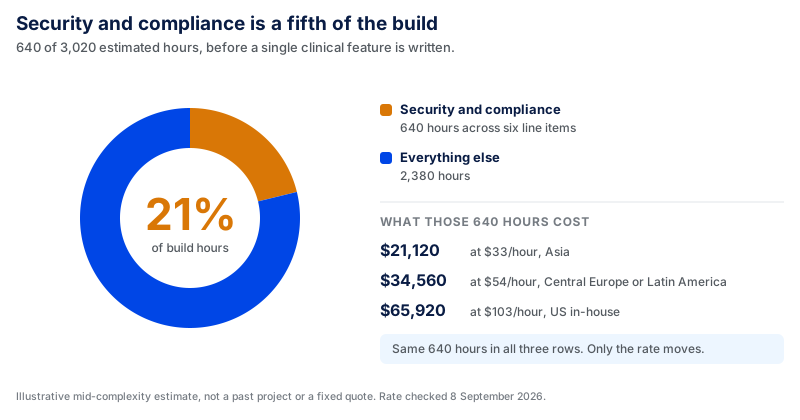
Security and compliance account for 640 hours, or 21% of the estimated development work. At $33 per hour, these tasks cost $21,120. Cleveroad estimates $10,000 to $30,000+ for regulatory compliance and security features, but its estimate does not provide the hours for this work.
The cost changes with the labour rate. The same 640 hours cost $34,560 at $54 per hour and $65,920 at $103 per hour. The security requirements remain the same, but the hourly rate changes the total.
The 640 hours represent security and compliance work in this estimate. They do not represent the additional cost of building healthcare software compared with another type of app. Some security functions like login, backups, and activity logs are also present in non-healthcare applications.
How Long Does It Take to Develop a Telemedicine App?
The 3,020 development hours are divided into phases over approximately 26 weeks. Some phases run at the same time, so the week's ranges overlap.
| Phase | Hours | Cost at $33/hour | Weeks |
|---|---|---|---|
| Discovery, workflow mapping, and security risk analysis | 230 | $7,590 | 1-3 weeks |
| UX/UI design for three surfaces | 200 | $6,600 | 3-6 weeks |
| Patient app, clinician console, admin, and compliance work | 1,670 | $55,110 | 5-22 weeks |
| EHR over FHIR and e-prescribing integrations | 380 | $12,540 | 10-20 weeks |
| QA and security checks | 300 | $9,900 | 8-24 weeks |
| DevOps, environments, and store submission | 110 | $3,630 | 20-26 weeks |
| Project management | 130 | $4,290 | 1-26 |
| Total | 3,020 | $99,660 | ~26 weeks |
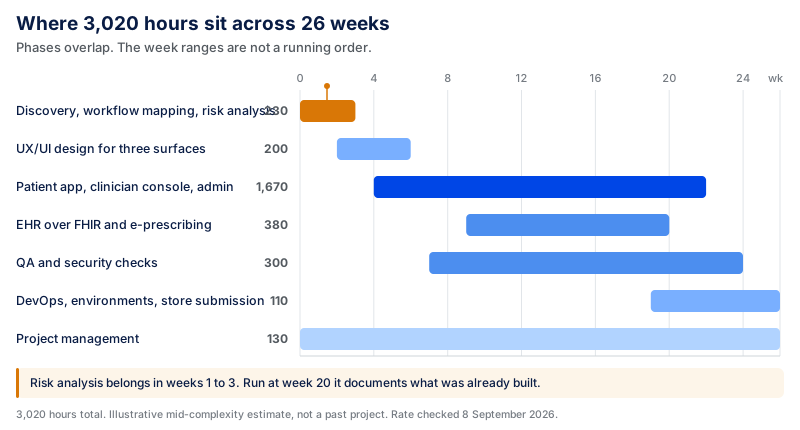
The 90-hour risk analysis sits in the first phase of that table, not the third, and that placement is the point. Two scheduling facts are worth raising with a vendor. The risk analysis belongs in weeks 1 to 3, not week 20. It is required at 164.308(a)(1)(ii)(A), and its output is supposed to shape the architecture. Done at the end, it becomes a document that describes what you already built. The integrations start in week 10 because they depend on somebody else's calendar. Sandbox credentials, a customer-side Epic implementation queue and an e-prescribing network's testing slots are not in the vendor's control. That is why they are more likely to delay the launch than to increase the budget.
Telemedicine App Cost by Development Region
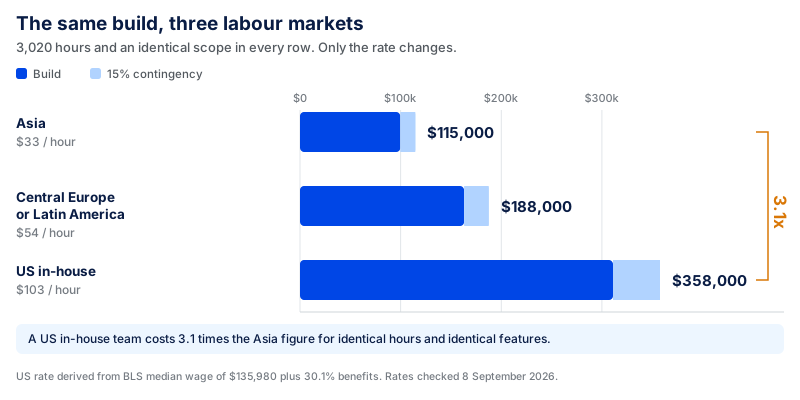
The table uses the same 3,020 development hours for each region to show how labour rates change the total cost. The rates use the midpoint of Accelerance's published ranges: $33 per hour for Asia and $54 per hour for Central and Eastern Europe and Latin America.
| Development region | Rate | Cost for 3,020 hours | 15% contingency | Total |
|---|---|---|---|---|
| Asia | $33/hour | $99,660 | $14,949 | $115,000 |
| Central/Eastern Europe or Latin America | $54/hour | $163,080 | $24,462 | $188,000 |
| US in-house | $103/hour | $311,060 | $46,659 | $358,000 |
Rates checked 8 September 2026.
The US rate is calculated from employment data rather than an agency rate. The Bureau of Labor Statistics reports a median annual wage of $135,980 for software developers as of May 2025. Wages account for 69.9% of private-industry compensation, with benefits accounting for 30.1%. This gives an estimated fully loaded cost of about $194,500 per year or $103 per hour.
At $103 per hour, the same 3,020-hour scope costs about 3.1 times the amount calculated at $33 per hour. The features and development hours remain unchanged. This shows how the labour rate alone can significantly change the project estimate.
Telemedicine App Costs After Launch
Telemedicine app expenses continue after development. Video usage, app store fees, cloud services, security checks, accessibility, and maintenance should be part of the post-launch budget.
- Clinical video: Amazon Chime SDK charges $0.0017 per attendee-minute for WebRTC media and appears on the AWS HIPAA-eligible services list. A 20-minute consultation with two people costs $0.068. At 2,500 visits per month, video costs about $170 monthly. Recording those visits in composited 1080p at $0.0125 per minute would add about $625 per month.
- App store fees: Apple Developer Program membership costs $99 per year, and Google Play registration costs $25 once. Apple's App Review Guidelines also set rules for payments for services consumed outside the app and restrict storing personal health information in iCloud.
- Cloud infrastructure: Compute, storage, bandwidth, and log retention create separate usage-based expenses. Calculate these costs from expected patient volume, stored data, and traffic. Our cloud migration cost guide explains common cloud expenses in more detail.
- Security checks: Cobalt lists an autonomous web application pentest at $3,500 through December 31, 2026. Forasoft estimates an external penetration test at $8,000 to $25,000 and SOC 2 Type II audit and readiness at $20,000 to $45,000.
- Accessibility: Forasoft estimates a WCAG 2.2 audit at $5,000 to $15,000 per release. Planning accessibility during design also reduces later changes to contrast, keyboard navigation, captions, and screen-reader support.
- Maintenance: Annual maintenance typically runs around 15% to 25% of the initial build cost. For the $115,000 example in this guide, that equals about $17,250 to $28,750 per year.
- Patient acquisition: Marketing and patient acquisition have their own budget. Keep these expenses separate from the software development estimate.
Three-Year Telemedicine App Cost
The three-year cost includes the initial $115,000 build and recurring expenses after launch. The table below calculates the total with annual maintenance at 15% and 25% of the development cost.
| Cumulative spend | 15% Annual Maintenance | 25% annual maintenance |
|---|---|---|
| Year 1 | $120,600 | $120,600 |
| Year 2 | $143,500 | $155,000 |
| Year 3 | $166,400 | $189,400 |
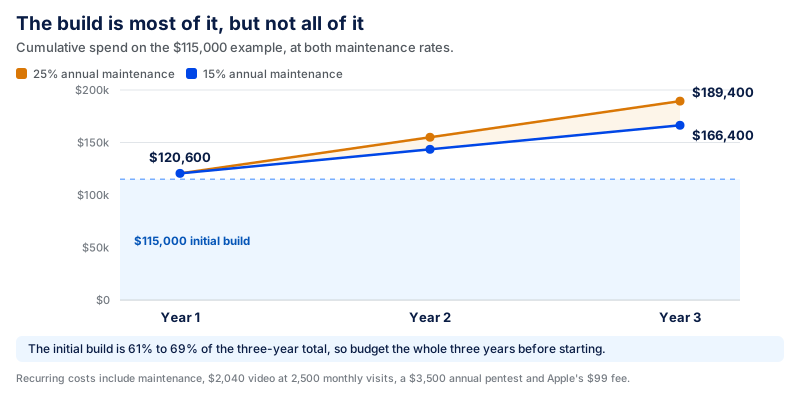
Recurring expenses include $17,250 to $28,750 in annual maintenance, about $2,040 per year for video at 2,500 monthly visits, a $3,500 annual penetration test, and Apple's $99 yearly developer fee. Cloud hosting, accessibility audits, patient acquisition, e-prescribing, and payment fees are separate.
The initial build accounts for about 61% to 69% of the estimated three-year cost. This is the main reason why the full three-year budget should be calculated before development starts.
Understanding the Regulatory Landscape for Telemedicine
Telemedicine regulations can change anytime. Current rules already set dates that affect controlled-substance prescribing and Medicare telehealth coverage.
The DEA telemedicine prescribing extension allows eligible DEA-registered practitioners to prescribe Schedule II–V controlled medications through telemedicine without a prior in-person medical evaluation. The current extension runs through December 31, 2026. Apps that support controlled-substance prescribing should account for changes after this date.
Medicare telehealth flexibilities remain in effect through December 31, 2027. They allow Medicare beneficiaries to receive many telehealth services from home and continue temporary changes to geographic restrictions. Products serving Medicare patients should account for this date when planning reimbursement features.
Clinical recommendation features also require regulatory review. FDA Clinical Decision Support guidance states that giving a specific diagnosis or treatment recommendation may not qualify as Non-Device CDS. Check the FDA Digital Health Policy Navigator before adding AI features.
When You Should Not Build a Custom Telemedicine App
A custom telemedicine app is not always the best financial option. For a small or mid-sized practice with standard video, scheduling, messaging, and e-prescribing workflows, an existing platform can cost much less.
SimplePractice pricing lists group plans at $99 per month for the first clinician and $74 for each additional practitioner. A 12-clinician practice would pay about $913 per month or $11,000 per year before add-ons. Compare that with the custom platform in this guide (which reaches about $166,400 to $189,400 over three years). Doxy.me pricing also offers a free plan and paid options.
Custom development is easier to justify when:
- The existing platform cannot handle your clinical workflow.
- You have to integrate with an EHR, payer system, medical device, or another system that packaged software does not support. Epic on FHIR provides a sandbox for checking Epic integrations.
- You are building a multi-provider network, payer platform, or white-label telemedicine product.
You should reconsider custom development when:
- Your budget only accounts for development. The example in this guide has annual maintenance of $17,250 to $28,750 before hosting and other operating expenses.
- No clinician is available to review workflows and clinical decisions during development.
- Patient demand has not been validated. A subscription platform can support a pilot before you invest in custom software.
- Your launch deadline is shorter than the development timeline. The MVP estimate in this guide is 3 to 5 months.
How to Reduce Telemedicine App Development Cost
You can reduce the budget by limiting the first release and using existing services where practical. Security and compliance should be part of the project from the start.
- Start with core features - Start with video visits, scheduling, secure messaging, and consent. E-prescribing and EHR integration account for 380 hours in this estimate and can be planned for a later release if the first version does not rely on them.
- Plan compliance early - The estimate assigns 640 hours to this work. Adding access controls, audit logs, encryption, backups, and emergency access after launch can create additional development and data migration work.
- Choose cross-platform - React Native or Flutter allows the team to develop iOS and Android apps from one shared codebase. Riseup Labs estimates cross-platform development can reduce costs by 30% to 50% compared with separate native apps. In our mobile app development cost guide, one shared client saves about 25% compared with two native clients for the example scope.
- Limit app interfaces - The estimate has a patient app, clinician portal, and admin dashboard. Using the clinician portal for initial administrative tasks can remove separate admin design, frontend, and QA hours from the first release.
- Use existing video services - Integrate a HIPAA-eligible video service instead of developing and operating your own video infrastructure. At the usage level in this example, Amazon Chime SDK video costs about $170 per month for 2,500 twenty-minute visits.
- Hire healthcare developers - Developers familiar with HIPAA security requirements can account for access controls, audit logging, encryption, backups, and other compliance work during project estimation.
Telemedicine App Development Scoping Checklist
Complete this checklist before requesting a development quote. It gives the vendor the information needed to estimate development hours, integrations, compliance work, and ongoing costs.
| Item | Your input | What to check |
|---|---|---|
| Clinicians and specialties | Roles, permissions, and licensing | |
| Expected visits per month | Usage-based costs | |
| Average visit length | Video usage cost | |
| Visit recording | Recording and storage costs | |
| Platforms | iOS, Android, web, or cross-platform | |
| EHR | FHIR API and sandbox access | |
| Other integrations | Payments, e-prescribing, identity, eligibility, and labs | |
| Controlled-substance prescribing | DEA requirements | |
| Diagnosis or treatment recommendations | FDA regulatory review | |
| Payer mix | Reimbursement requirements | |
| Development hours and rate | Hours by role and hourly rate | |
| Compliance work | Security and compliance hours separately | |
| Contingency | 15% in this estimate | |
| Annual maintenance | 15–25% of build cost | |
| Three-year cost | Development and post-launch expenses |
Build Your Healthcare Software with Coding Crafts
Coding Crafts estimates healthcare software by breaking the project into development hours, integrations, security work, and contingency. Our senior engineers charge $25 to $49 per hour. Security and compliance tasks are listed separately so you can see how much development time goes into each part of the project.
Our healthcare experience includes a credentialing platform for provider onboarding, verification, and document review. The case study reports that the platform reduced onboarding time from two to four weeks to one to two weeks. We have also worked on a business management platform used by more than 19,000 dental practices and organizations. Its case study reports an estimated 30% to 40% reduction in administrative work related to vendor management.
We have not published a patient-facing telemedicine case study. These projects show our experience with healthcare software, multi-role access, and document management. They should not be presented as evidence of previous telemedicine development.
Frequently Asked Questions
How much does it cost to develop a telemedicine app?
Telemedicine app development ranges from $40,000 to $300,000+. Our mid-complexity estimate is about $115,000.
Why do telemedicine apps cost more than regular apps?
Security, compliance, clinical workflows, and healthcare integrations increase development work.
What does HIPAA compliance actually add to the cost?
Our estimate assigns 640 hours and about $21,100 to security and compliance work.
How long does telemedicine app development take?
Development takes about 3 to 5 months for an MVP and 9 months or more for a full platform.
Should I build one at all, or subscribe?
Build for custom workflows or integrations. Choose a subscription for standard practice workflows.
The Bottom Line
Telemedicine app development starts at around $40,000 to $70,000 for an MVP. Clinical features, integrations, security, and compliance work increase the total cost. Compare development teams by estimated hours, hourly rate, security work, and three-year cost. Coding Crafts shows each of these items separately in its healthcare software estimates.
Healthcare software with compliance built in
Coding Crafts builds healthcare platforms with HIPAA security requirements from the start. Senior engineers charge $25 to $49 per hour, and telemedicine estimates list development and compliance work separately before the project begins.
More from the blog.
View all postsRelated reading from the Coding Crafts team.